
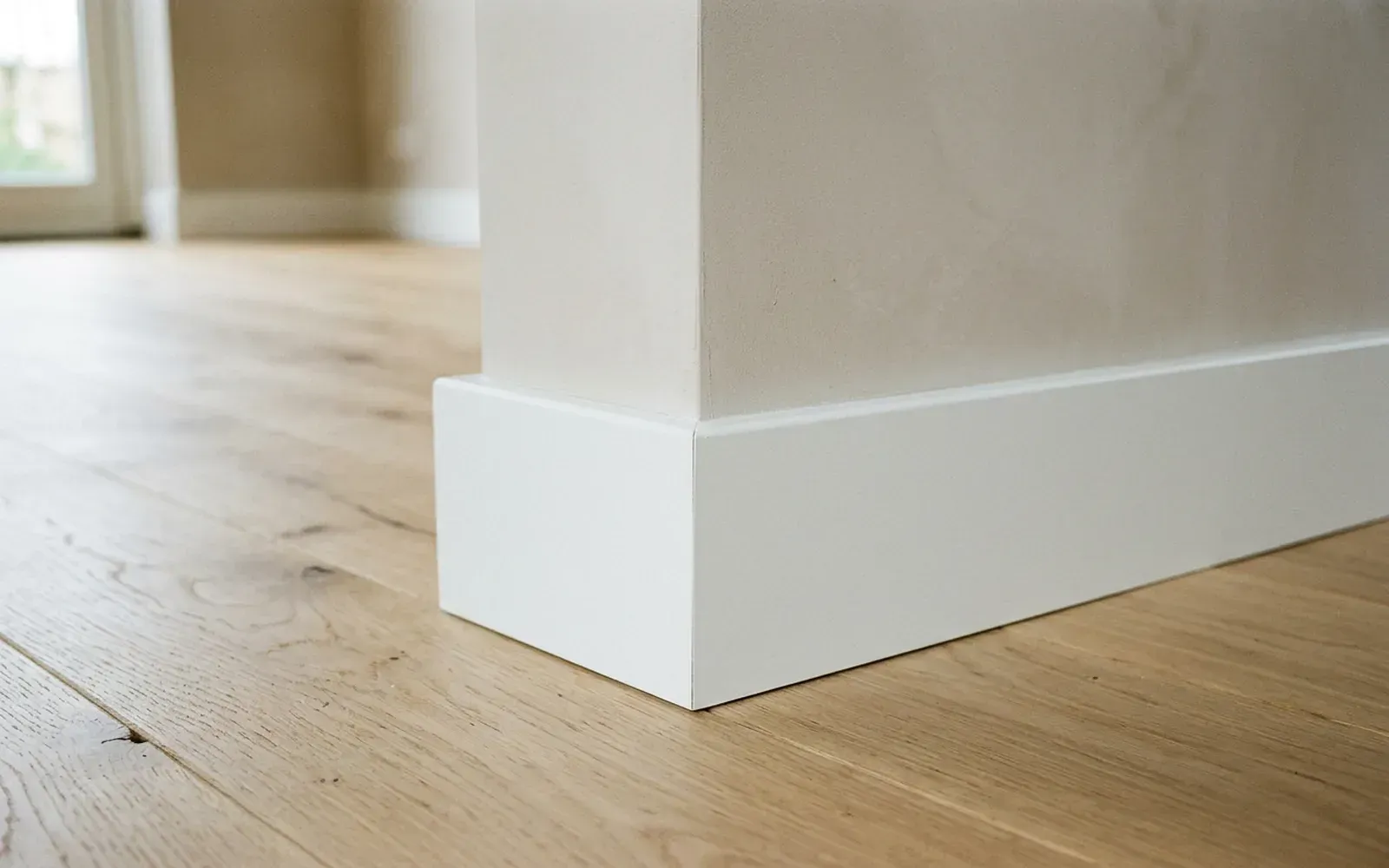
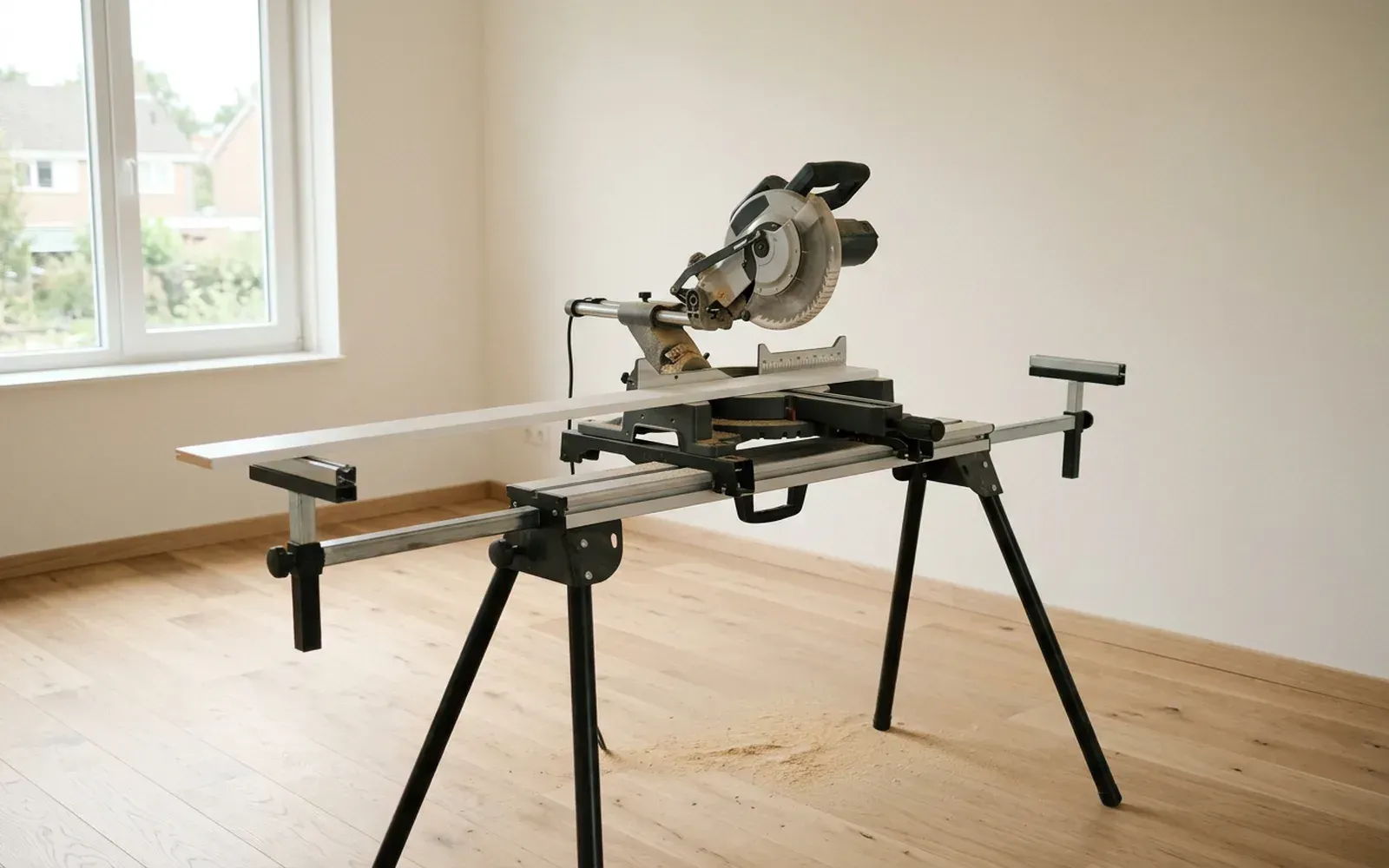
Mitre cutting skirting boards works like this: for a square 90-degree corner, you cut both skirting boards at 45 degrees, so that together they form the corner exactly. If the corner is not square, you measure the actual angle and halve it; each piece gets half. The hardest part is not the sawing but the measuring: in most homes, corners are just off 90 degrees, and then a standard mitre will not close.
Below you can read how to get skirting boards to meet tightly in a corner, what the difference is between an internal and an external corner, and how to deal with corners that are out of square.
What is a mitre?
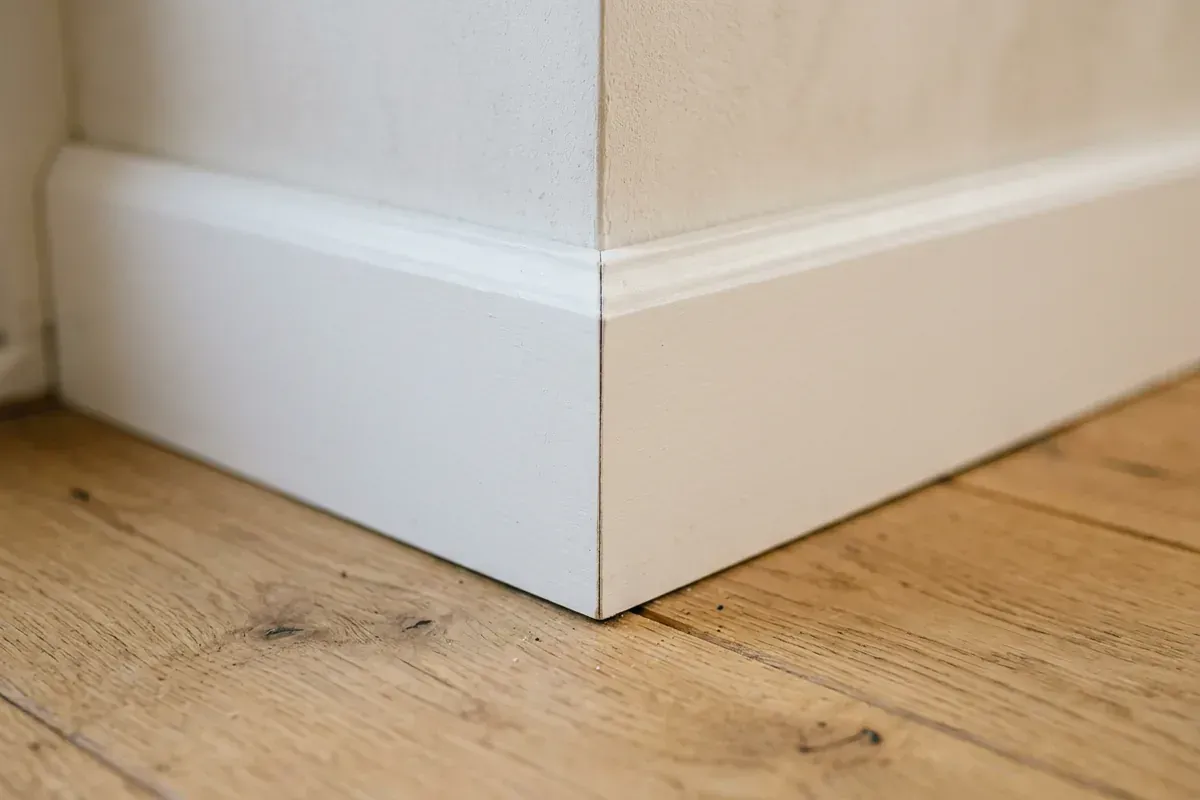
A mitre is an angled joint between two pieces that together form a corner. Instead of cutting the skirting boards square and butting them together, both pieces get an angled cut. This lets the profile of the skirting run unbroken around the corner. With mouldings such as decorative mouldings and coving the principle is the same, although an extra angle comes into play because the moulding sits at an angle between wall and ceiling.
Internal and external corners
With skirting boards you deal with two kinds of corner. You can find more on this in the glossary under internal and external corners.
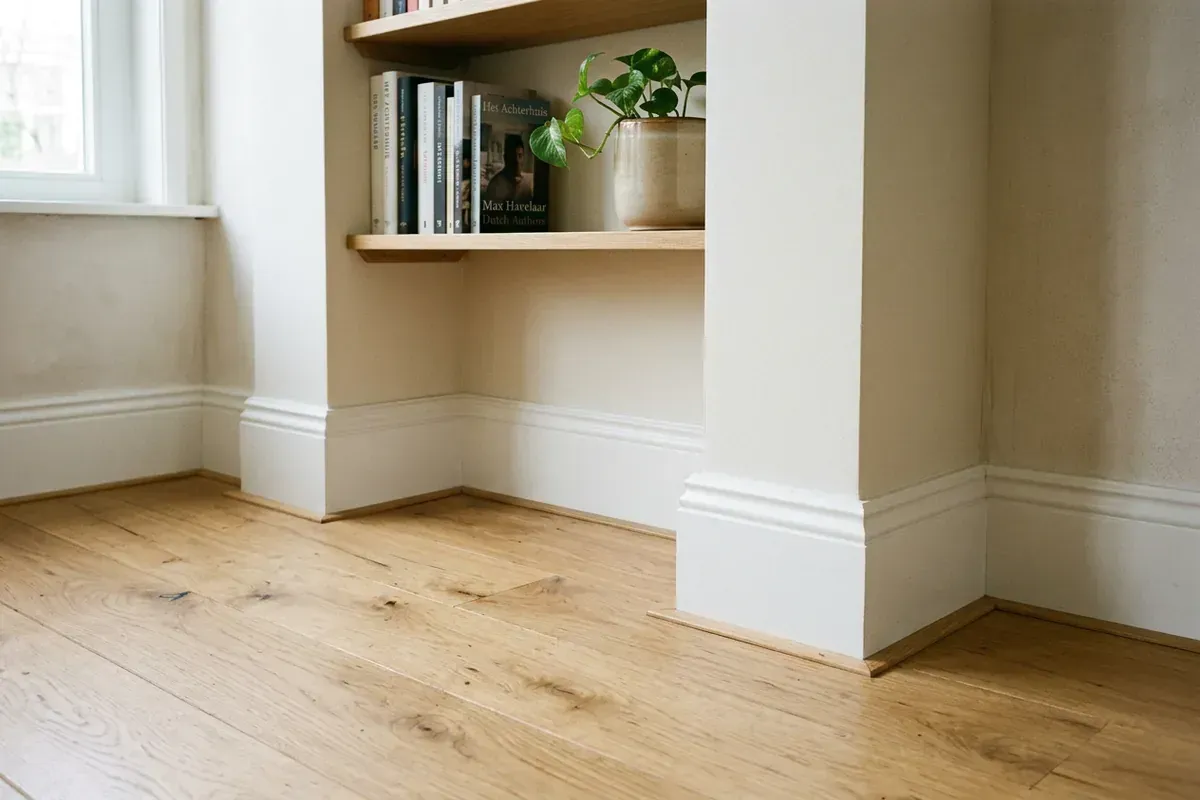
- Internal corner: the corner points away from you, like the corner of a room. The long point of the mitre is at the back of the skirting board, against the wall.
- External corner: the corner sticks out towards you, for example at a chimney breast, an alcove or a projecting wall return. The long point of the mitre is at the front, on the visible face.
An external corner is the most visible and the least forgiving. A small gap in an internal corner can still disappear with caulk; an open external corner always stands out.
Why halve the angle?
Two skirting boards that together form a corner must each cover exactly half of that angle. For a square corner that is 90 divided by 2: both pieces at 45 degrees.
If the angle is different, you work it out the same way:
| Measured angle | Half angle per board | Example |
|---|---|---|
| 90° | 45° | Standard room corner |
| 88° or 92° | 44° or 46° | Slightly out-of-square corner |
| 135° | 67.5° relative to the wall | Corner at a bay window or angled wall |
Note: many mitre saws show the angle relative to a straight square cut. A square mitre is then set at 45, but for a 135-degree corner you set the saw to 22.5 degrees (90 minus 67.5). So always check how your saw indicates the angle and cut a test piece first.
How to measure a corner
Never assume a corner is square. Even in a new build a corner can be a few degrees out, and in older properties that is the rule rather than the exception.
- Measure at skirting height. A corner can be different at the bottom than halfway up the wall. Measure where the skirting board will go.
- Use an angle finder or sliding bevel. A digital angle finder shows the actual angle straight away; with a sliding bevel you copy the angle and transfer it to the saw.
- Halve the measured angle. That is the angle each piece gets.
- Cut a test piece. Two short offcuts show immediately whether the joint fits, before you cut into the full length.
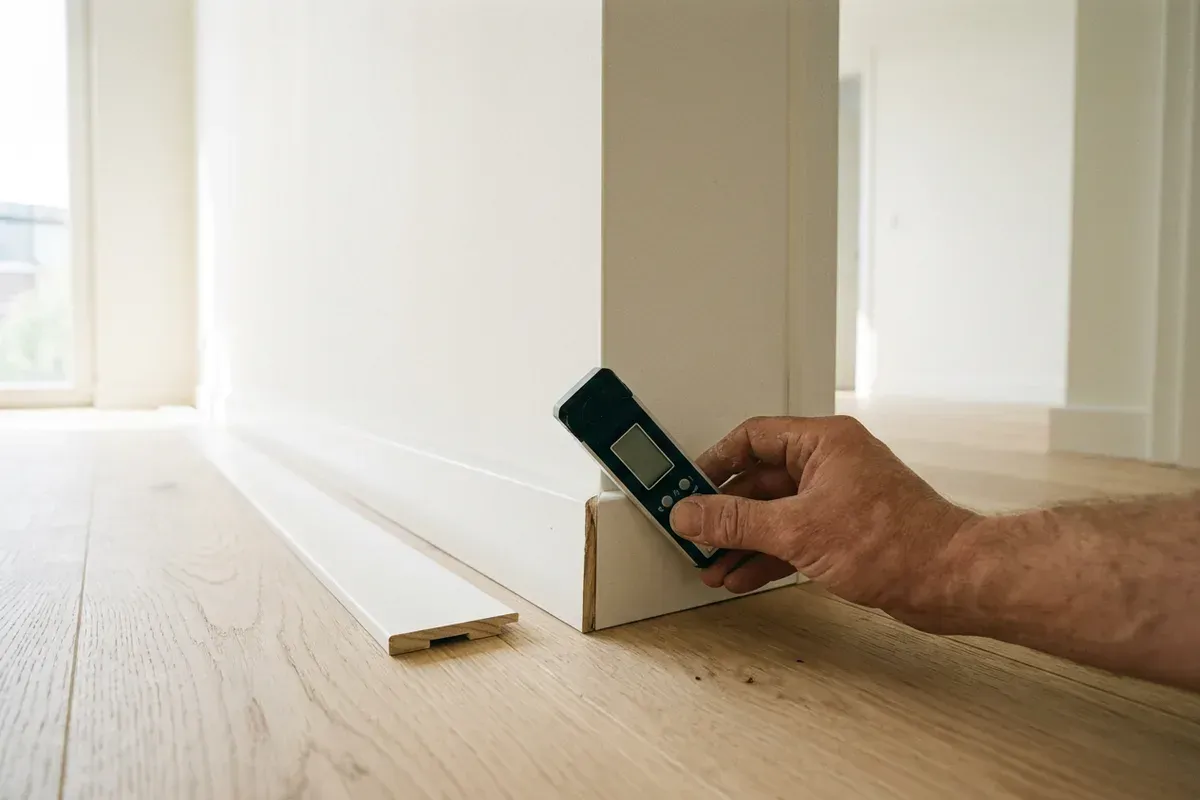
Mitre cutting skirting boards: step by step
- Measure the length along the wall. For an internal corner you measure right into the corner; for an external corner, to the corner point of the wall. Depending on the type of corner, the length applies to the side against the wall or to the visible face.
- Mark the cutting direction. Draw a pencil line showing which side must stay long. This prevents you from cutting the mitre the wrong way round.
- Hold the skirting board steady on the saw. The board stands upright against the fence, just as it will later stand against the wall. A board that tilts while you cut gives a crooked cut.
- Cut steadily and all the way through. A sharp blade with fine teeth prevents chipping of the paint or lacquer finish.
- Dry-fit. Place both pieces in the corner without adhesive and check the joint. If it is slightly out, plane or sand very lightly, or recut.
- Fix and glue the mitre. On external corners the mitre itself is often glued as well, so the corner cannot open up.
When does a mitre not work?
For a profiled skirting board in an internal corner, professionals sometimes choose a different joint: one board runs straight into the corner and the other is cut to the profile of the first. This method, known as scribing or coping, gives a better fit when the wall is not square and is less likely to open up when the material moves.
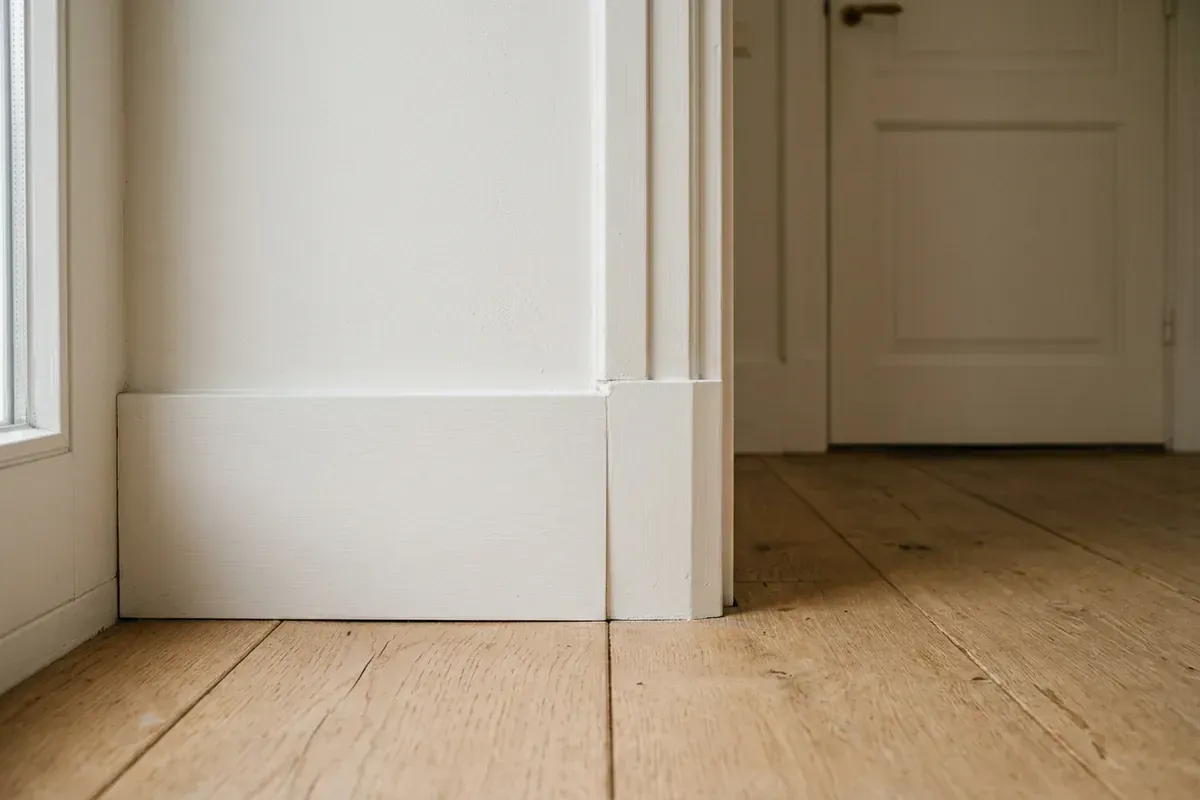
At a free end, for example against a door frame or at an open side of a staircase, there is no second board to cut against. There you use an end cap or a short return mitre that covers the end grain.
Unusual corners and uneven walls
The older the property or the more irregular the floor plan, the more the corners deviate. In the apartment in Oss with irregular walls and unusual corners, the skirting boards were made entirely to measure and fitted on site. At the hotel in Maastricht, millimetre-precise mitres were needed in the wall panels and decorative mouldings, finished in RAL 9010.
If not only the corner but also the wall itself is out of true, there is more to it than a good mitre. Read more in skirting boards on uneven walls.
Finishing: caulking and touching up
After fitting, the mitre is finished off. A minimal gap in an internal corner can be filled with paintable acrylic caulk and painted over. The cut edges of a pre-finished skirting board are touched up in the same colour, so the core of the material does not remain visible. You can read more about the right sealant in caulking skirting boards: which sealant?.
DIY or hire a professional?
With a good mitre saw, an angle finder and some patience, you can finish a simple room yourself. With many corners, out-of-square corners, tall skirting boards or a dark colour in which every joint shows, professional work is quicker to see in the result. You can weigh up the options in fitting skirting boards yourself or hiring a professional. On skirting board installation you can read how TipTop Plinten approaches corners and mitres; for mouldings on ceilings and walls, see decorative mouldings and coving.
Request a quote
Do you have a room with many or tricky corners? Send a few photos and an estimate of the number of metres via contact. The quote is free and without obligation. An on-site measurement is optional for €75 incl. VAT and is credited on jobs above a minimum project size. We are happy to communicate in English, as well as Dutch, German, Turkish, Persian and Arabic.
Frequently asked questions
For a square 90-degree corner, you cut both skirting boards at 45 degrees. If the corner is not square, measure the actual angle and halve it. Each piece then gets half of the measured angle, so the two pieces meet exactly.
An internal corner points away from you, like the corner of a room. An external corner sticks out towards you, like the corner of a chimney breast or a wall return. On an internal corner the long side of the mitre sits against the wall; on an external corner it is on the visible face.
Usually the corner is not exactly square, the wall is not plumb or the floor is not level. A saw that is not set precisely or a board that shifts while you cut will also leave an open joint. Always measure the angle first and cut a test piece.
A very small gap in an internal corner can be filled with acrylic caulk and then painted over. An open external corner stays visible, even with caulk. There, recutting a mitre that fits is the better solution.
At a door frame, an open side of a staircase or a free end, you can use an end cap or a short return mitre that covers the end grain. That way the cross-section of the skirting board is not visible and the profile finishes neatly.
Related articles
Installation & finishing
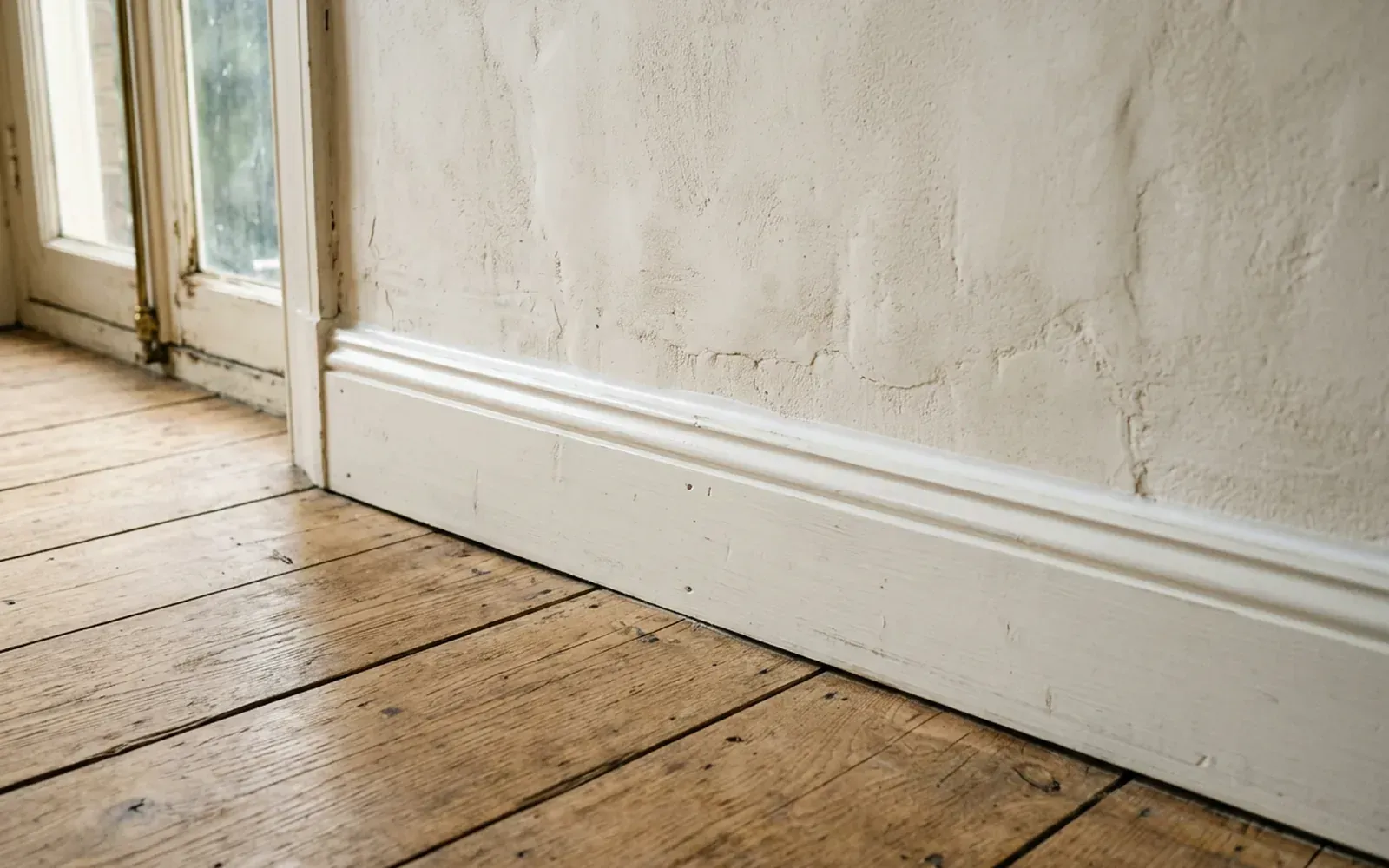
Skirting boards for uneven walls: made-to-measure skirting for irregular walls
With out-of-true, wavy or subsided walls, standard skirting won't sit flush. This is how a made-to-measure skirting board is fitted to the wall, floor and corner.
Installation & finishing
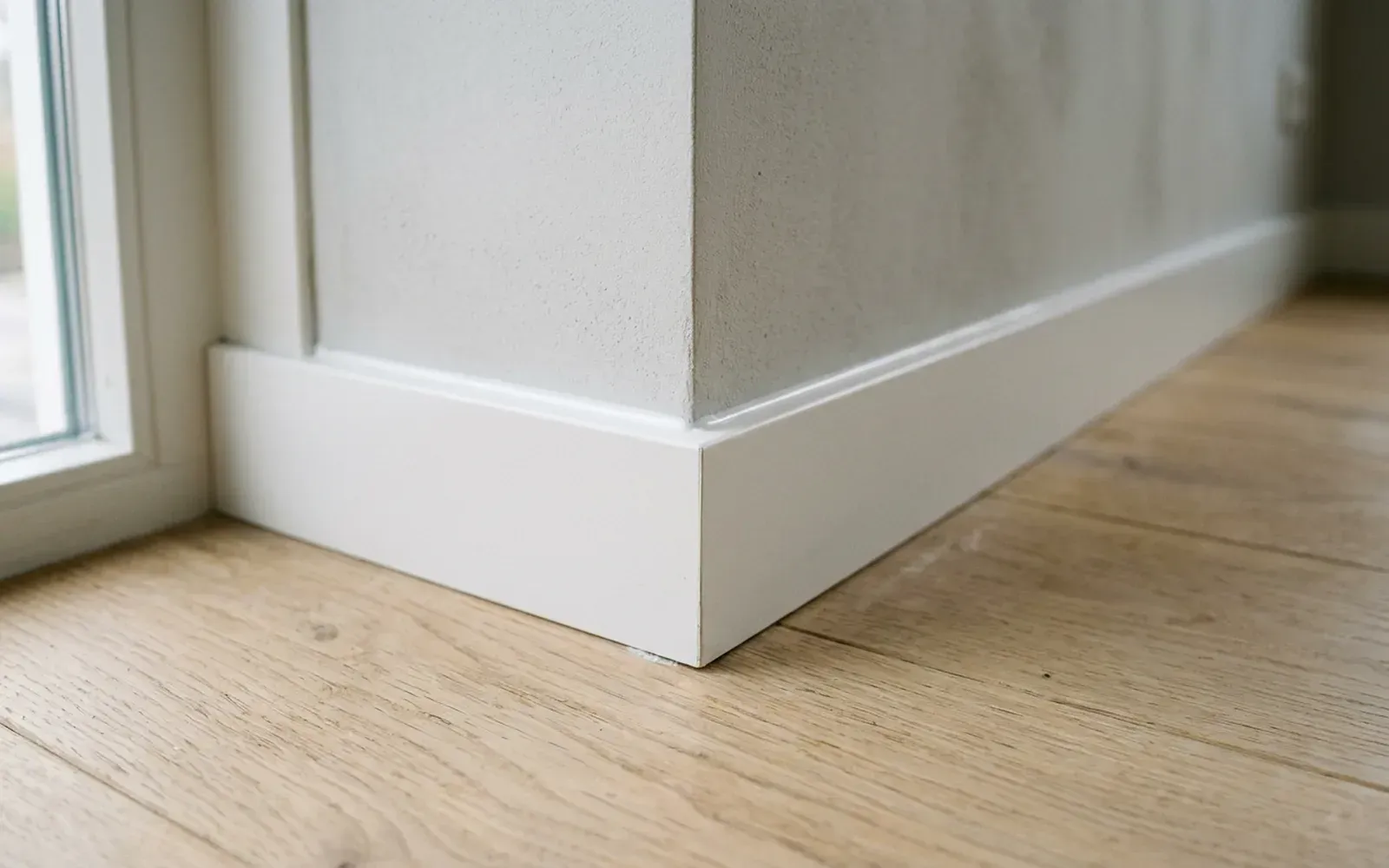
Caulking skirting boards: which sealant should you use and how do you get a neat finish?
For the joint between skirting board and wall you use paintable acrylic caulk, and silicone only where water is involved. Here is how to run a clean caulk line.
Costs & process
Fitting skirting boards: do it yourself or hire a professional?
Fitting skirting boards yourself works well in a simple room. With lots of corners, uneven walls or a striking colour, a professional pays off. Here is how to weigh it up.
Related
Mitre joint
A mitre is an angled cut that lets two mouldings meet seamlessly in a corner. For a right angle, that is usually 2 x 45 degrees.
Internal & external corner
An internal corner points away from you, an external corner points towards you. With skirting boards, each type of corner needs its own cutting direction and approach.
Skirting end
A skirting board that stops somewhere needs a neat finish. That can be a mitred return, an end cap or a junction with an architrave.
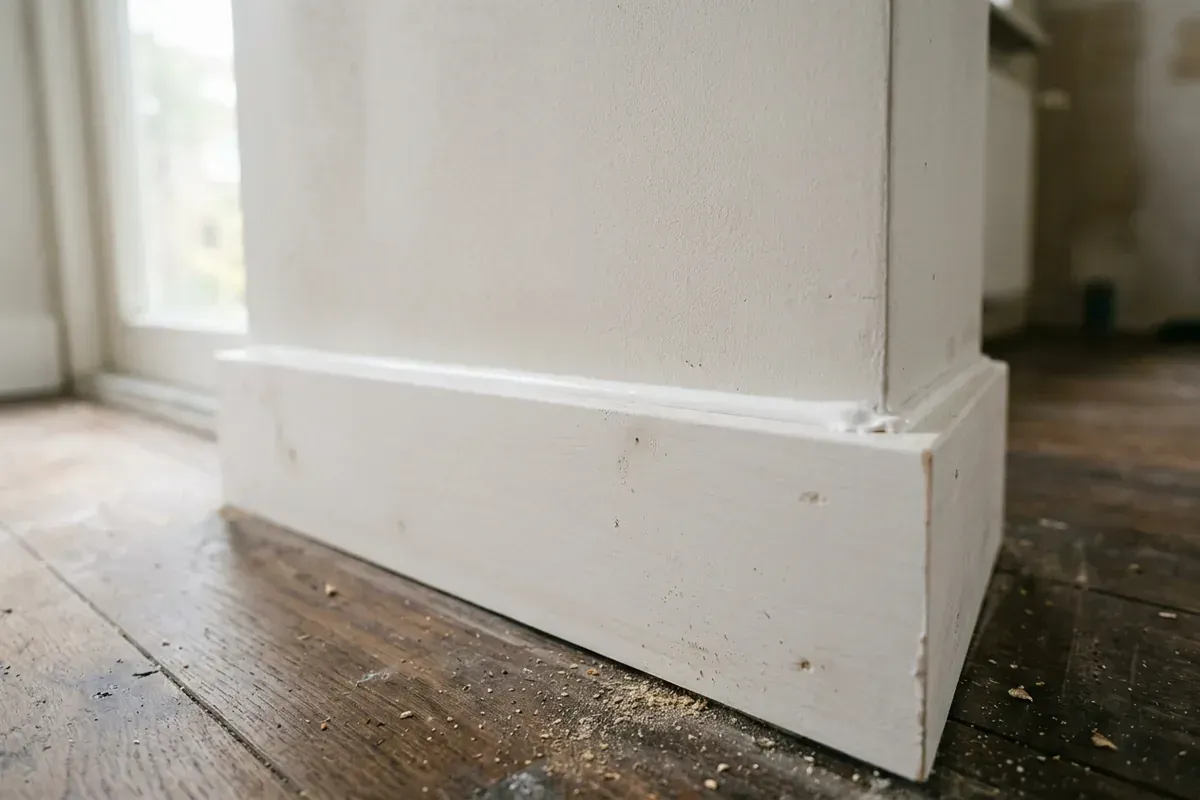
Acrylic caulk
Acrylic caulk is a water-based sealant that can be painted once cured. It is the usual choice for skirting boards, mouldings and frames in dry rooms.
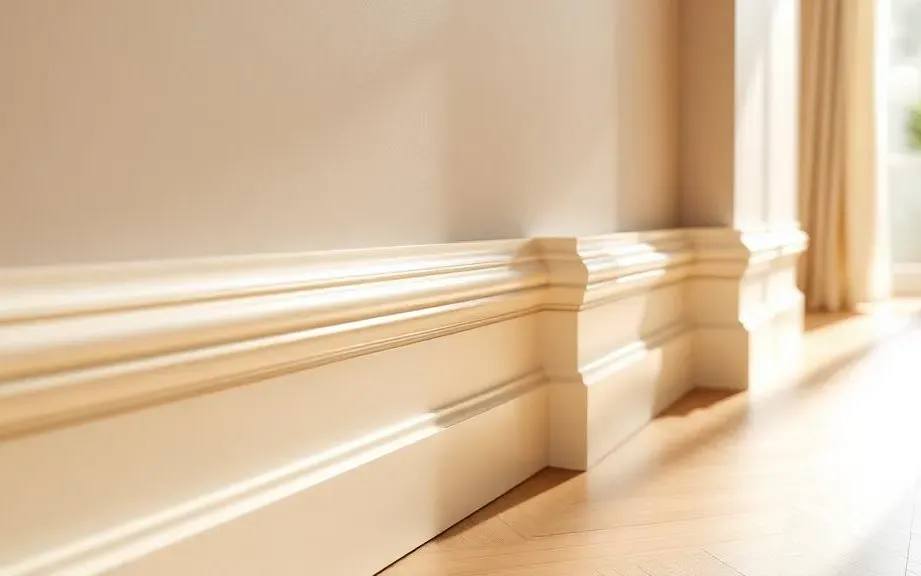
Skirting board installation by a specialist skirting fitter
TipTop Plinten fits skirting boards in MDF, solid wood and aluminium, finished in any RAL colour and neatly matched to any floor, even with uneven walls.
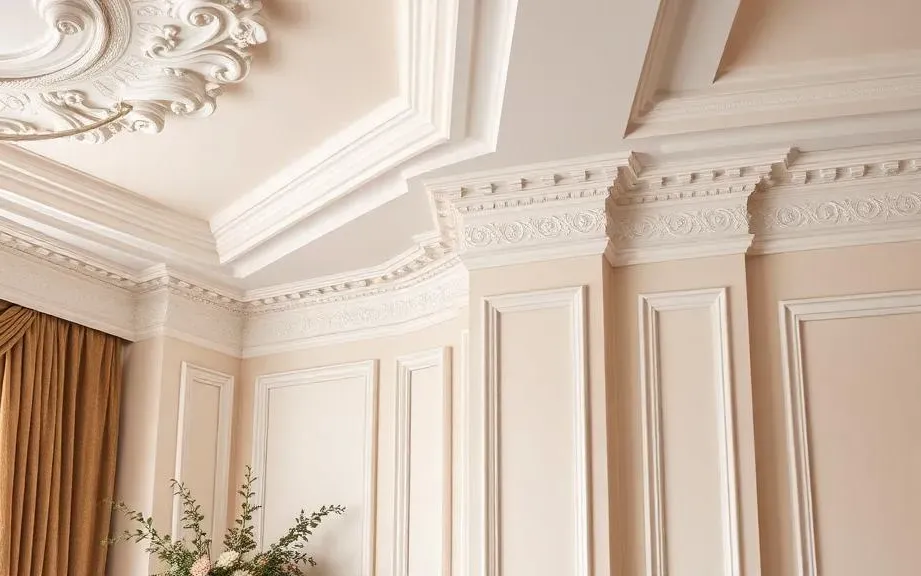
Decorative mouldings and coving installation
Decorative mouldings and coving give a room character. TipTop Plinten fits them in classic or minimal modern styles, with precise mitres and clean caulking.
Skirting board installation? Request a free quote
On-site measurement €75 incl. VAT (credited for orders above a minimum project size)