
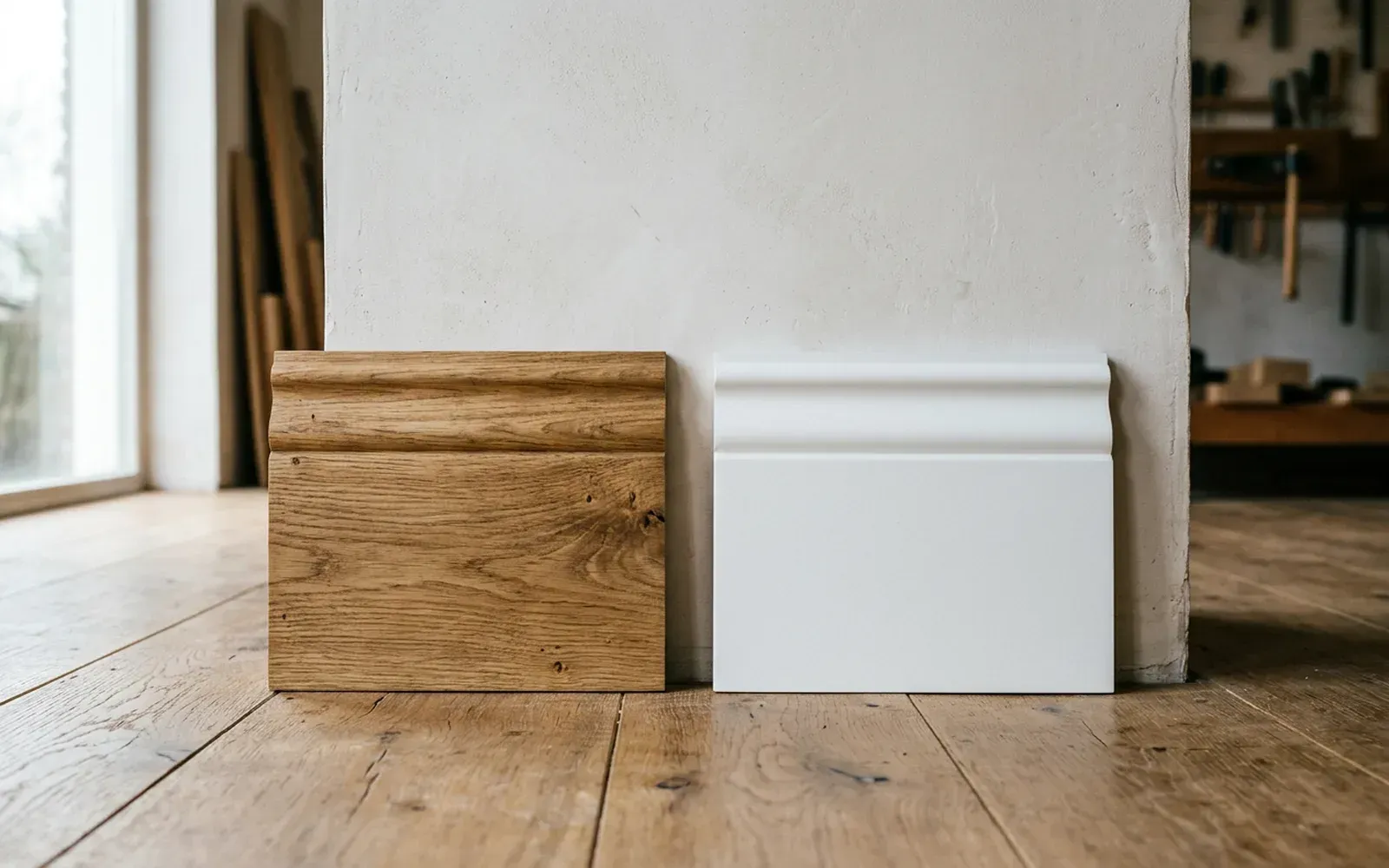
Wooden skirting boards or MDF: the short answer is that MDF is usually the best choice for a crisp, painted skirting board, and that solid wood skirting boards really come into their own in classic or characterful interiors, or when you want to keep the wood grain visible. Both materials can look excellent; the difference lies in stability, finish, moisture sensitivity and appearance. In this article we set out the differences clearly.
What is the difference between wooden and MDF skirting boards?
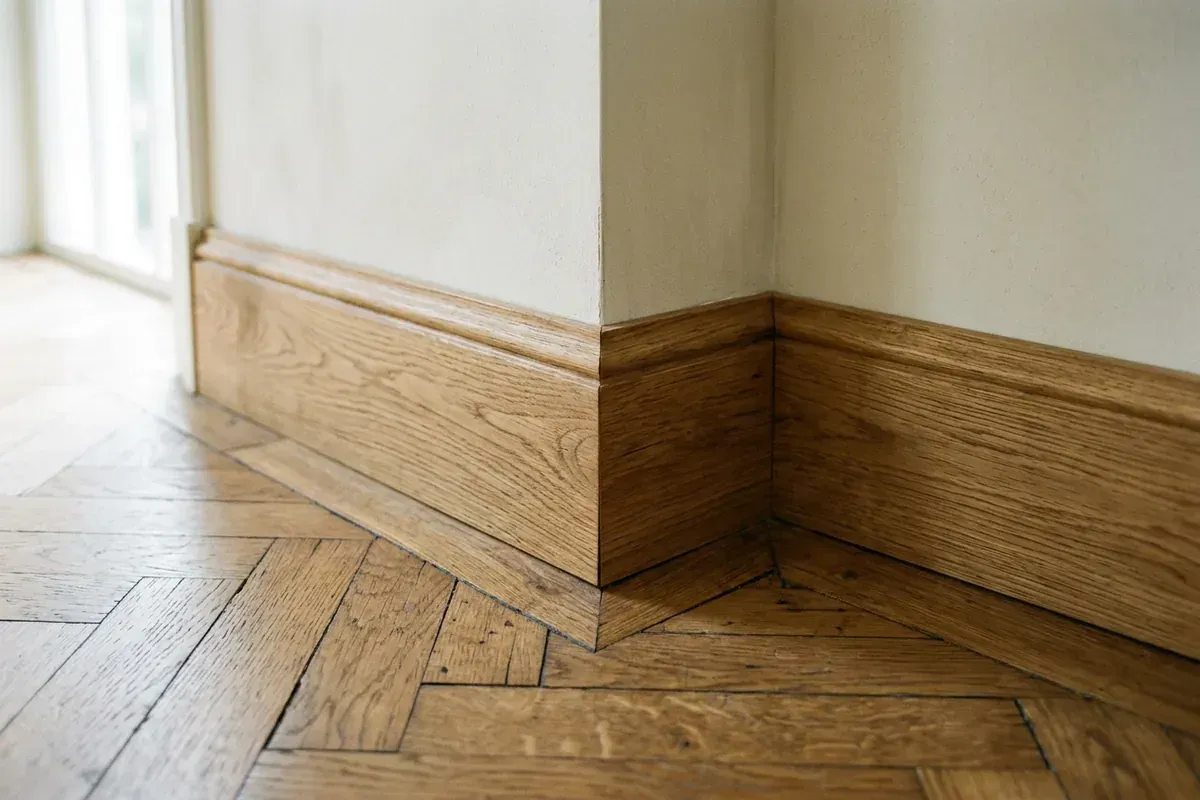
A solid wood skirting board is cut from a single piece of timber, for example pine, spruce, meranti or oak. The material has a natural grain, is strong and can be sanded and touched up if damaged. You can read more about the material in the glossary under solid wood.
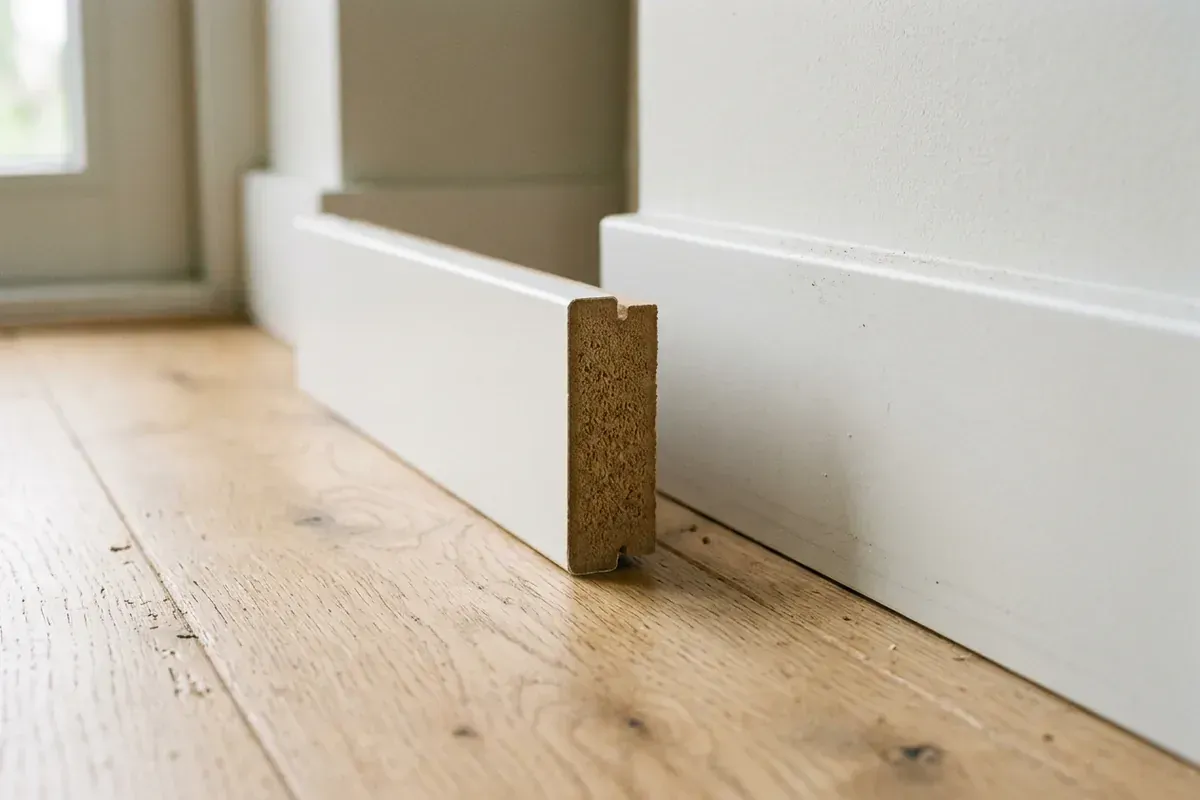
MDF stands for Medium Density Fibreboard: wood fibres pressed with resin under high pressure into a uniform board. Skirting boards are then machined from it. Because there is no grain and there are no knots, the surface is smooth and even. That makes MDF ideally suited to painting.
Overview at a glance
| Property | MDF | Solid wood |
|---|---|---|
| Dimensional stability | Very stable, hardly warps | Moves with moisture and temperature |
| Finish | Smooth, ideal for painting in any RAL colour | Painting, staining, oiling or left natural |
| Moisture sensitivity | Standard MDF is sensitive; moisture-resistant MDF copes better | Depends on wood species and finish |
| Repairability | Touch up minor damage with filler and paint | Sand and refinish |
| Look | Crisp, modern, even | Natural, warm, classic |
Advantages of solid wood skirting boards
Strong and impact-resistant. Solid wood can take a knock. In a hallway, stairwell or busy living room where vacuum cleaners and chair legs regularly hit the skirting, that is a plus.
Repairable. A dent or scratch in a wooden skirting board can be sanded and refinished. With oiled or clear-finished skirting, this can often be done locally.
Visible wood grain. If you actually want to show off the skirting, for example oak skirting with an oak staircase or oak frames, solid wood is the logical choice. MDF cannot offer that natural grain.
Suited to characterful buildings. Older homes and listed buildings often have tall, profiled wooden skirting boards. Anyone who wants to keep or restore that style often goes for wood again.
Disadvantages of wooden skirting boards
Wood moves. Solid wood expands and shrinks with humidity. This can lead to small gaps in mitres, or a skirting board that warps slightly. Good installation and an even finish on all sides limit this, but it is a property of the material.
Knots and resin. With painted wooden skirting, knots and resin-rich areas can show through the paint over time. A suitable stain-blocking primer prevents a lot of problems, but it requires more preparation than MDF.
More finishing needed. A wooden skirting board often needs sanding, priming and several coats of paint for an even result. With pre-finished skirting in MDF, much of that work has already been done.
Advantages of MDF skirting boards
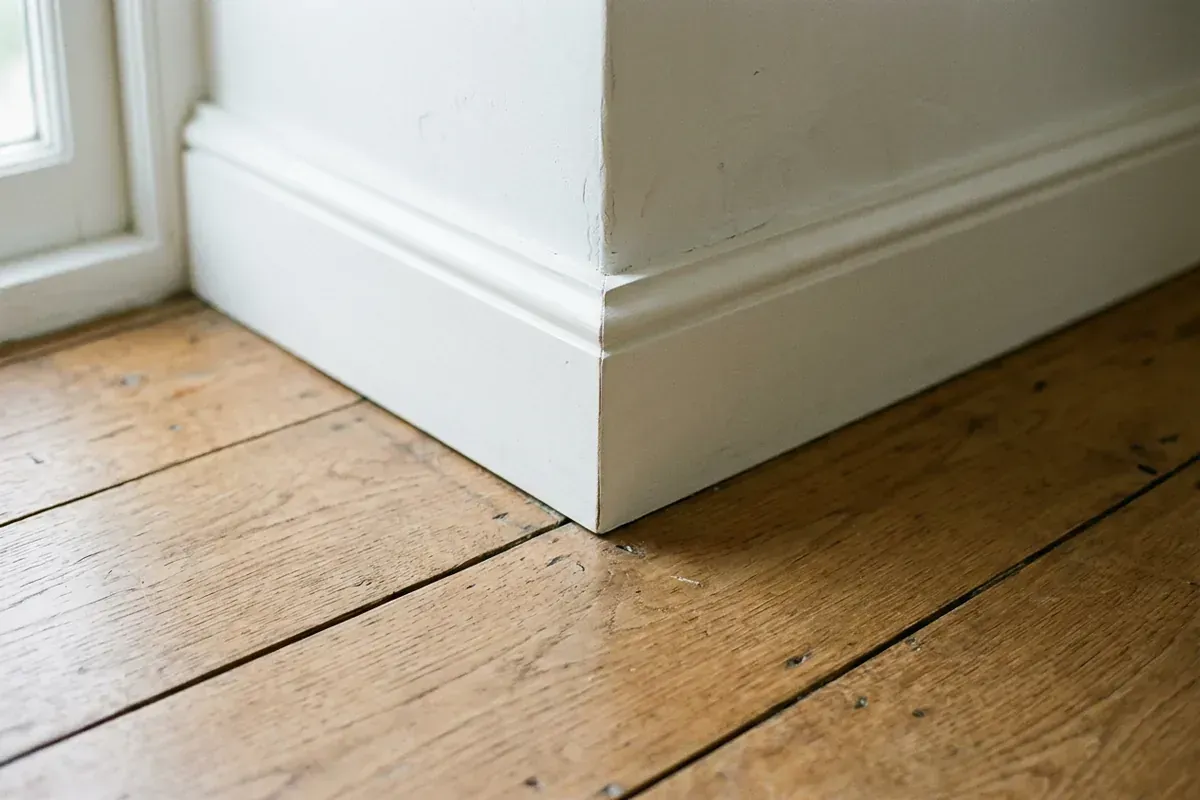
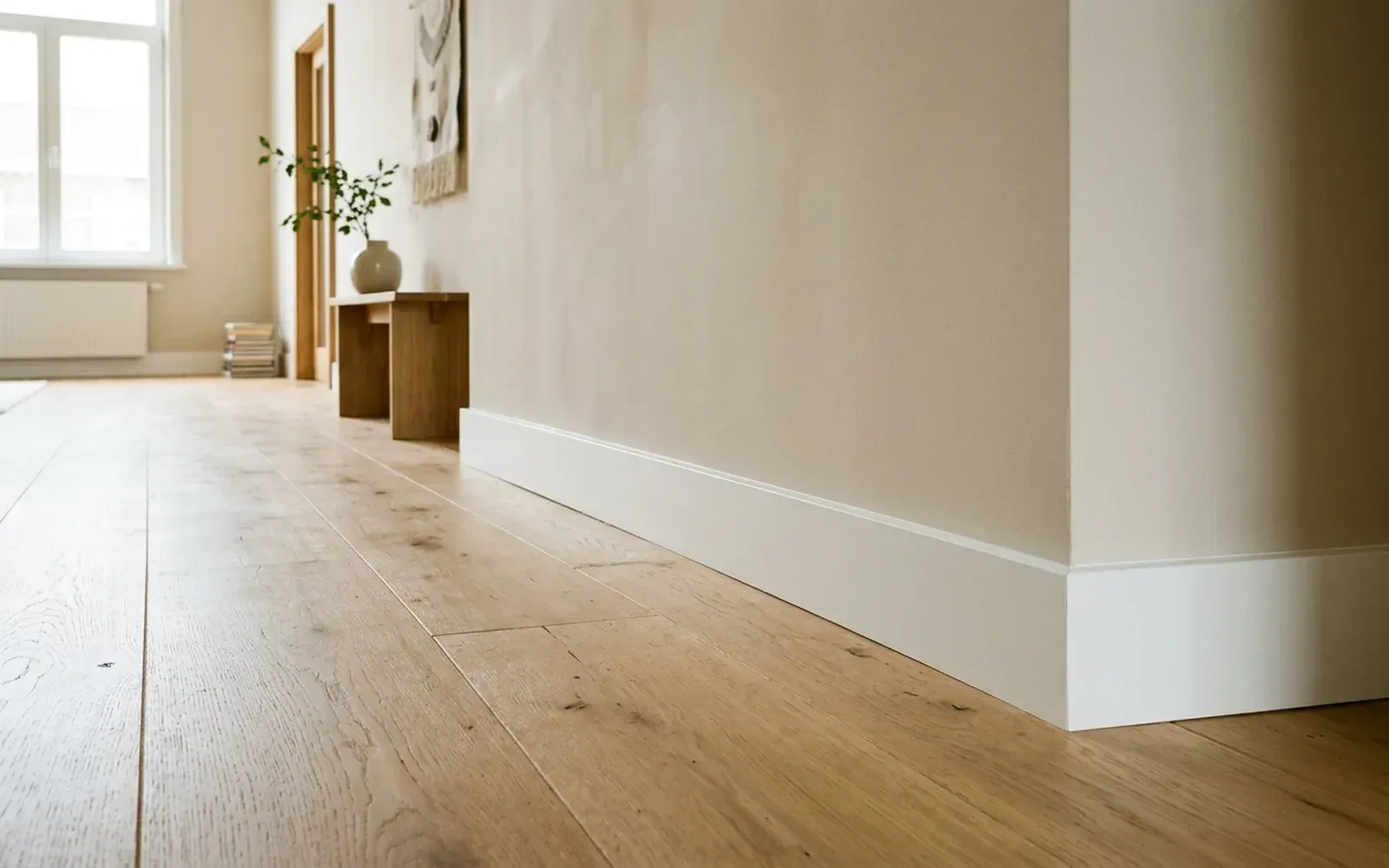
Crisp and even. MDF has no grain, no knots and no raised fibres. After painting you get a calm, uniform surface. That is why MDF is the most popular skirting board in modern homes.
Dimensionally stable. MDF moves much less than solid wood. As a result, mitres stay closed better and long lengths stay straight.
Any colour possible. MDF skirting boards can be finished in any RAL colour, from classic white in RAL 9010 to matt black in RAL 9005. They are available primed and paint-ready, or already pre-finished.
Many profiles and heights. From a sleek, straight skirting board to a tall, classically profiled one: MDF comes in many variations. Read more about the pros and cons in our article on MDF skirting boards.
Disadvantages of MDF skirting boards
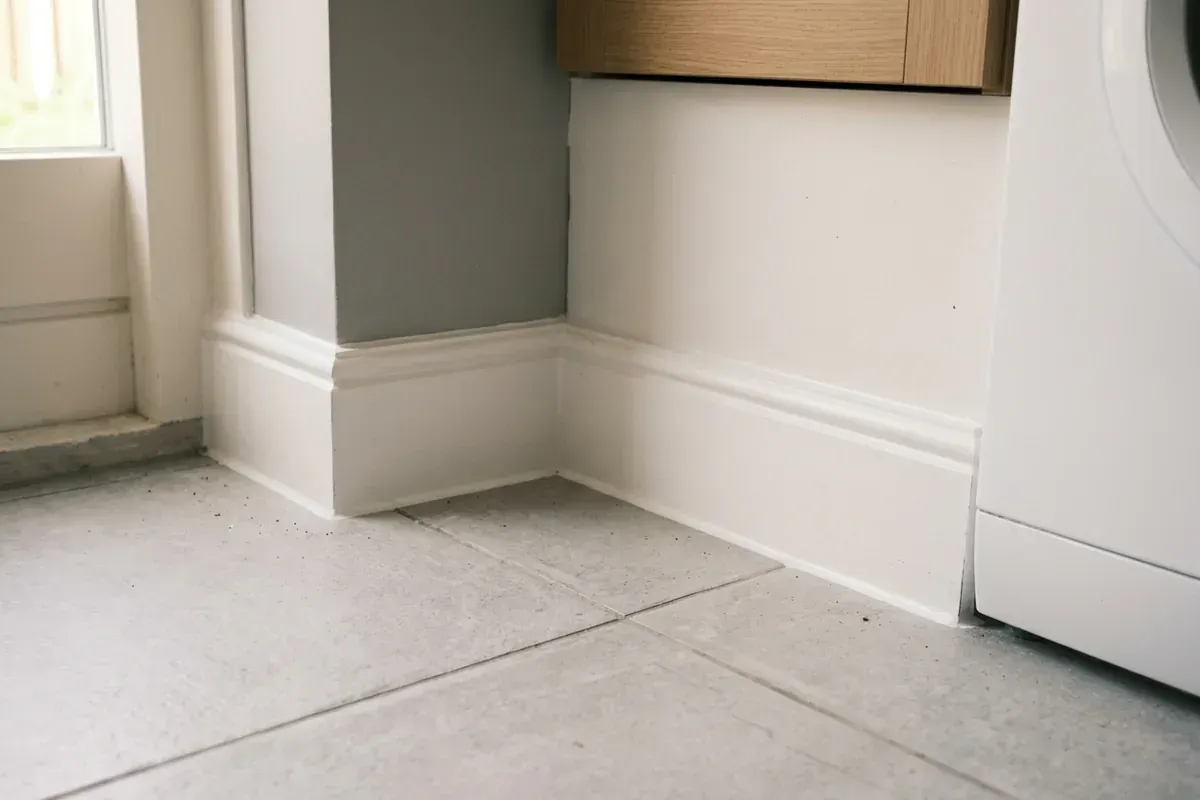
Sensitive to moisture. Standard MDF can swell if it gets wet for longer periods, especially at the bottom and where the paint is damaged. In damp rooms, moisture-resistant MDF is therefore the better choice. A well-caulked junction with the floor also helps.
Less impact-resistant than hardwood. A hard knock can dent MDF. This is easy to repair with filler and paint, but the material is a little softer than many wood species.
No natural grain. If you want skirting with visible wood, MDF is not an option.
When do you choose solid wood and when MDF?
A handy rule of thumb:
- Choose MDF if you want painted skirting, are after a crisp and calm look, or are finishing a modern home, flat or new build.
- Choose moisture-resistant MDF for the bathroom, toilet, utility room and entrance, or if the floor is often mopped wet.
- Choose solid wood if the grain needs to stay visible, if the skirting has to match other visible woodwork, or if you are finishing a characterful building in its original style.
With a historic building, something else comes into play too: out-of-true walls and irregular corners. The material then has to be fitted to measure. You can see an example at the historic home in Apeldoorn, a 19th-century building with subsided walls where made-to-measure skirting boards were fitted with respect for its historic character.
What does the choice mean for installation?
The material also matters for the fitting itself. MDF can be mitre-cut cleanly and stays dimensionally stable, which makes installation on long, straight walls predictable. Solid wood needs more attention to the movement of the material: the skirting has to acclimatise properly and be fixed firmly so that it does not pull away.
In both cases, precise caulking ensures a neat junction with the wall and floor. For the joint between skirting and wall, a paintable acrylic caulk is usually used. If you want to know how skirting boards are fixed, read our article on fixing skirting boards: glue or screws.
And plastic skirting boards?
Plastic skirting boards are available and are sometimes chosen because they are moisture-resistant. TipTop Plinten deliberately does not work with them. The look and finish of MDF, solid wood and aluminium are a better match for the quality we aim for. For damp areas, moisture-resistant MDF or aluminium is an alternative.
How do you make the choice easier?
Still unsure? Ask yourself these questions:
- Do you want to paint the skirting or see the wood grain?
- Is the room dry, or is there moisture involved?
- Does the skirting need to match other woodwork, such as a staircase or frames?
- How tall should the skirting be, and which profile suits the interior?
- Which floor is down: laminate, vinyl (PVC), parquet, herringbone or tiles?
With the answers to these questions, the choice usually becomes clear quickly. You will find a more extensive list in our checklist for choosing skirting boards, and in the article on painting skirting or pre-finished you can read more about the finish.
Having skirting boards fitted by TipTop Plinten
TipTop Plinten, based in 's-Hertogenbosch, fits MDF, solid wood and aluminium skirting boards throughout the Netherlands, including mitres, made-to-measure work for uneven walls and caulking. See the options on our skirting board installation page.
Torn between wood and MDF? Get in touch for advice and a free, no-obligation quote. We are happy to communicate in English. If you would like us to look at the situation in person, an on-site measurement is available for €75 incl. VAT; for projects above a minimum size, this amount is deducted from the final price.
Frequently asked questions
Not by definition. Solid wood is strong, repairable and has a natural look, but it moves with temperature and humidity. MDF is dimensionally stable, crisp and easy to paint in any colour. Which is better depends on the room, the floor and the look you want.
Yes. Solid wood can be painted in any RAL colour. Do watch out for knots and resin-rich areas: these must first be sealed with a suitable primer, otherwise they may show through the paint over time.
In rooms where moisture plays a role, such as a bathroom, toilet, utility room or a hallway by the front door, and with floors that are mopped wet. Moisture-resistant MDF copes better with moisture than standard MDF, but it is still not a material for standing water.
No. TipTop Plinten deliberately works with MDF, solid wood and aluminium. Plastic skirting boards are not fitted.
With an oak floor, many people choose calm white or light-coloured painted skirting so the floor gets the attention. Solid oak skirting is also possible, but then it is important that the colour and grain match the floor well; a slightly different shade often stands out more than a clear contrast.
Related articles
Choosing skirting
MDF skirting boards: pros, cons and when to choose them
MDF is the most popular material for skirting boards, but not the best choice in every situation. These are the advantages, the disadvantages and the pitfalls.
Choosing skirting
Which skirting boards to choose? A checklist for types, height and colour
Not sure which skirting boards to choose? This checklist takes you through every decision, from material and height to colour, floor and fixing, so you choose a skirting board that fits.
Installation & finishing
Painting skirting boards or choosing pre-finished: which is the smarter option?
Pre-finished skirting boards are ready straight away, while painting them yourself gives more freedom in colour. Here is how to choose and how to paint skirting boards neatly.
Related
Solid wood
Solid wood is timber in one piece, without pressed fibres. It gives skirting boards a natural look, but moves with temperature and humidity.
MDF
MDF is a sheet material made of pressed wood fibres. It is stable, smooth and easy to paint, which makes it the most popular material for skirting boards.
Moisture-resistant MDF
Moisture-resistant MDF is MDF treated to make it less sensitive to moisture. It is suitable for rooms where standard MDF would quickly swell.
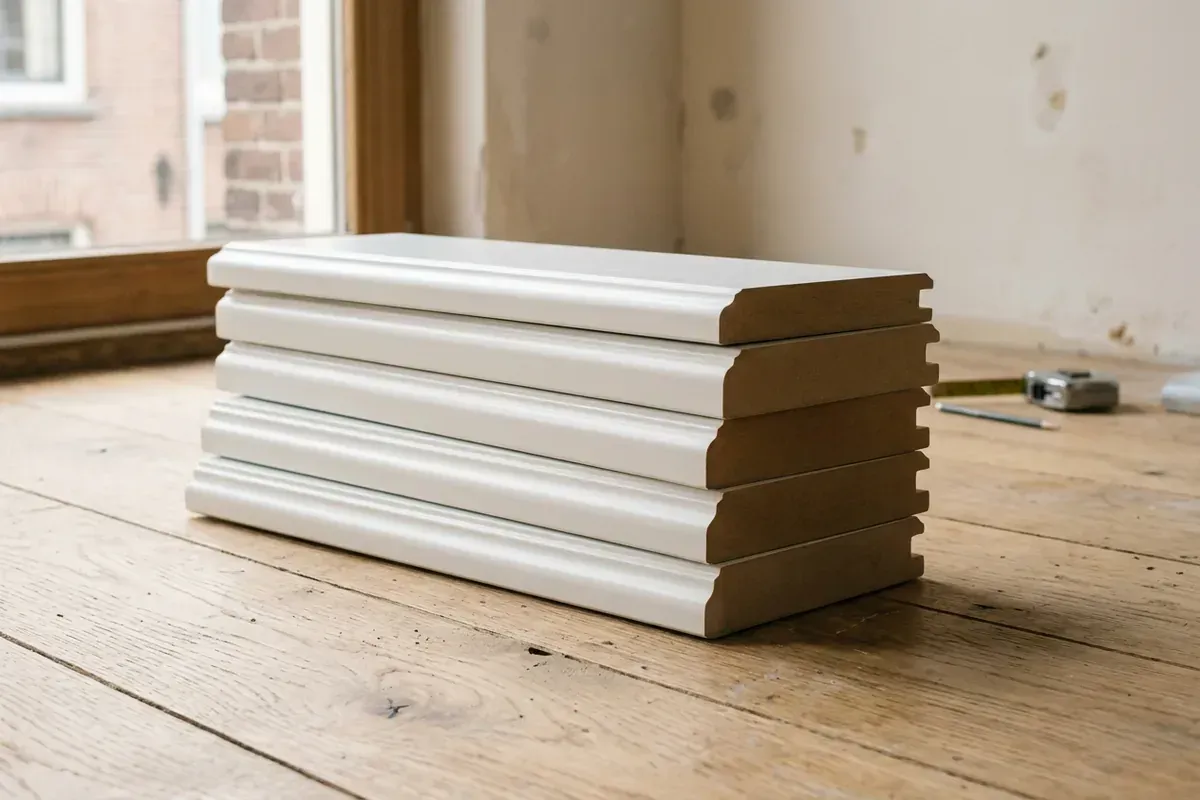
Pre-finished skirting
Pre-finished skirting has already been painted at the factory. That saves painting, but the joints and corners need neat touching up.
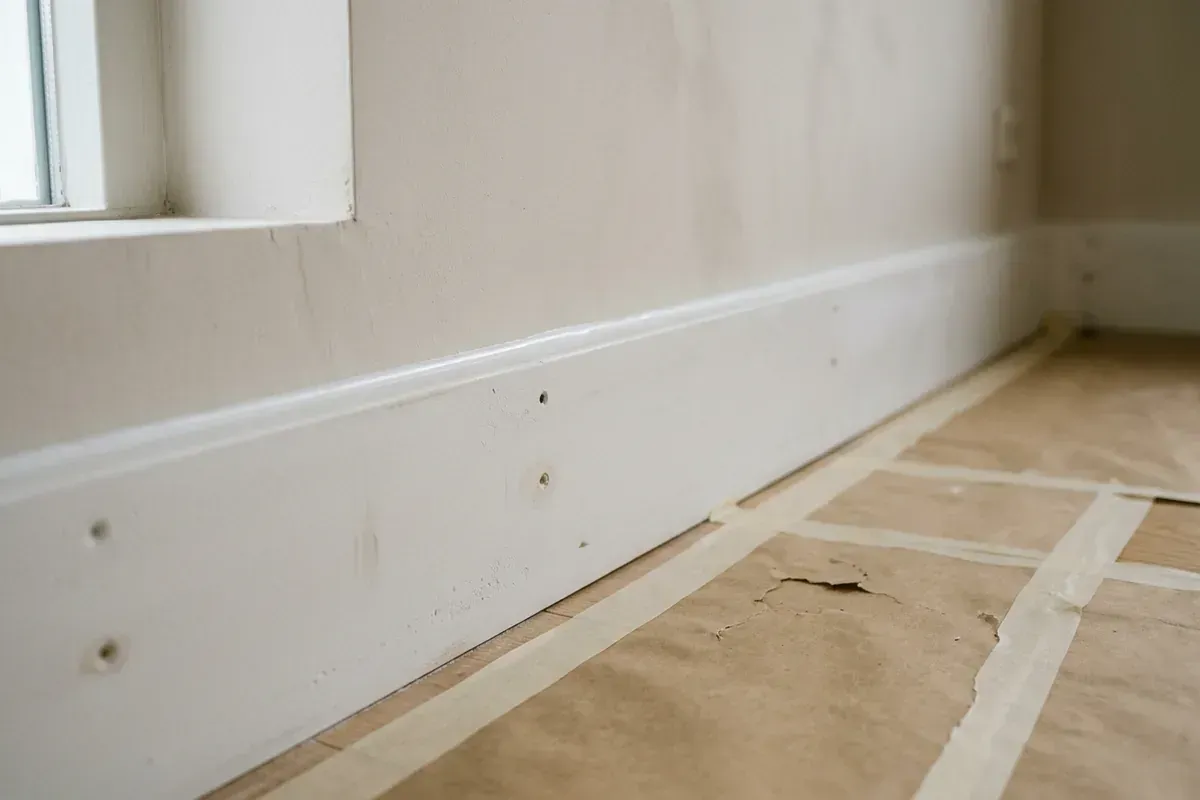
Paint-ready
Paint-ready means skirting boards and mouldings have been fitted, filled and caulked, so only the final coat of paint still needs to be applied.
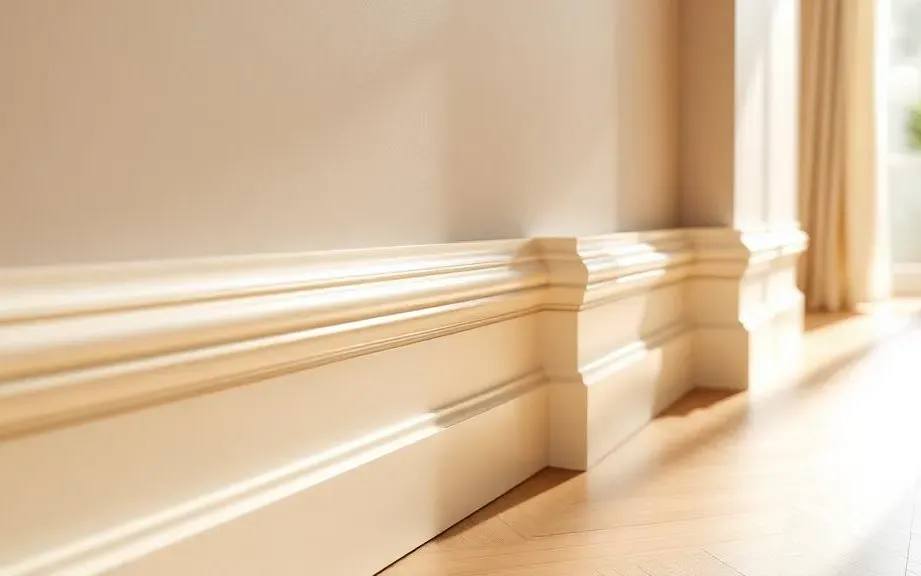
Skirting board installation by a specialist skirting fitter
TipTop Plinten fits skirting boards in MDF, solid wood and aluminium, finished in any RAL colour and neatly matched to any floor, even with uneven walls.
Skirting board installation? Request a free quote
On-site measurement €75 incl. VAT (credited for orders above a minimum project size)