
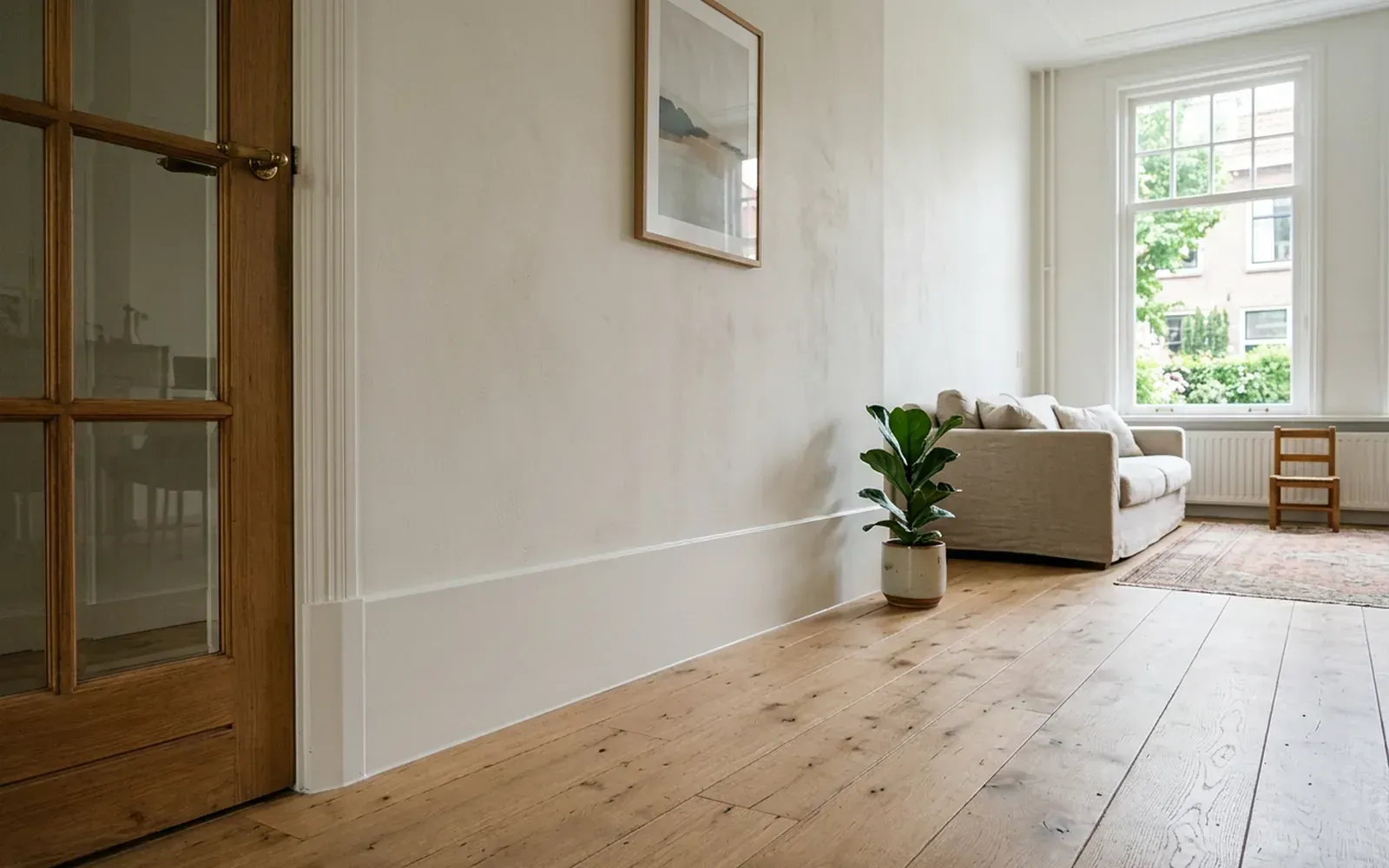
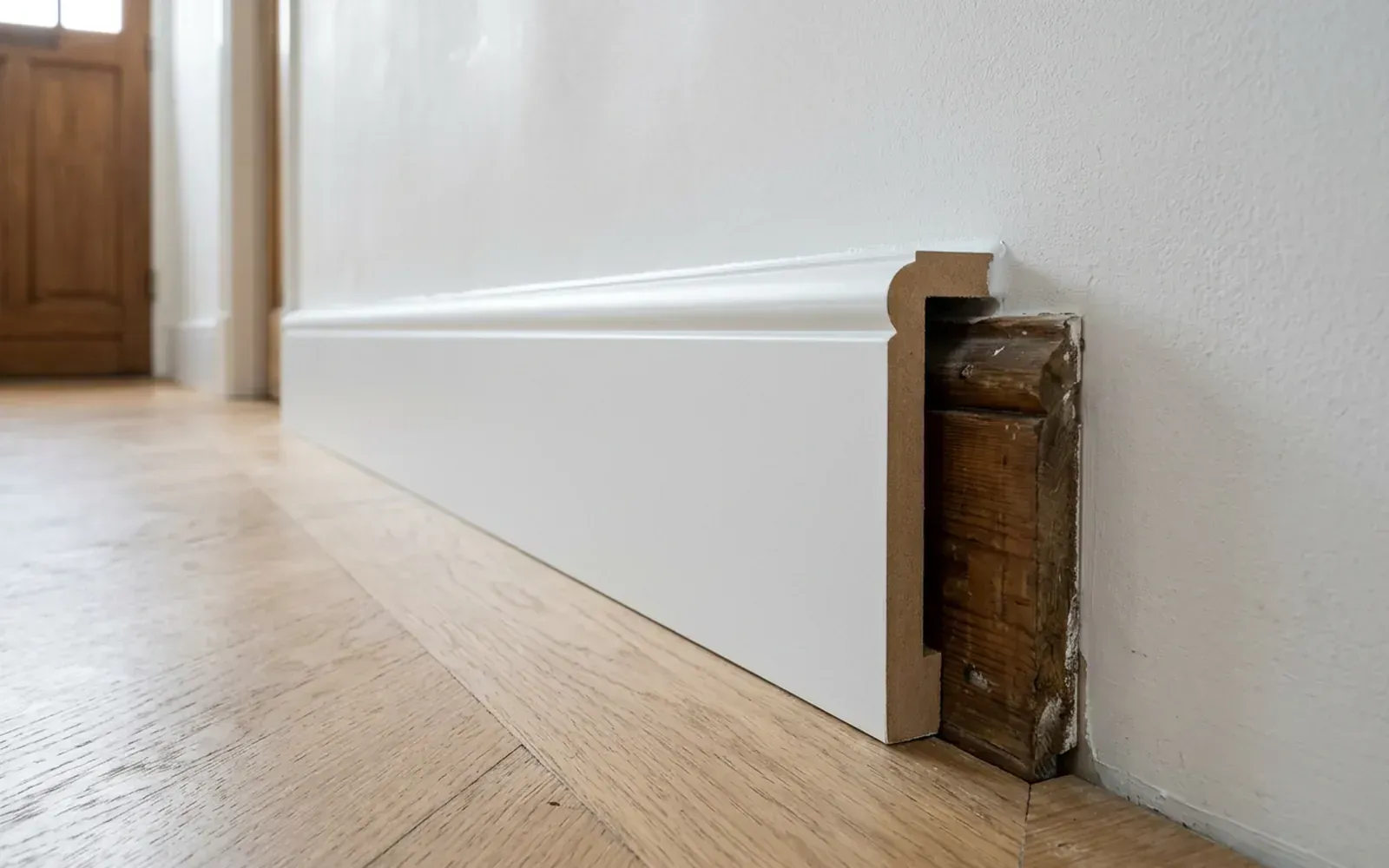
Tall skirting boards are skirting boards of about 12 cm and higher. Which height fits depends mainly on your ceiling height: in an average home with a ceiling of around 2.60 metres, skirting of 12 to 15 cm usually looks balanced, while rooms with a higher ceiling or a classic character can easily take 15 to 18 cm or more. The style of the interior, the colour of the walls and doors and the condition of the walls also play a part.
In this article you will learn how to determine the right skirting height, which mistakes we often see and what to look out for when fitting tall skirting boards.
What do we mean by tall skirting boards?
There is no official cut-off, but in the trade skirting up to about 9 cm is usually considered standard. From around 12 cm people speak of tall skirting. Common heights you will come across at suppliers are roughly 7, 9, 12, 15 and 18 cm, and for townhouses or large open-plan spaces there are also profiles of 20 cm and more.
Tall skirting boards were long typical of old townhouses and period properties. Today you also see them a lot in modern interiors: a sleek, tall skirting board in the same colour as the wall creates calm and makes the transition to the floor clearer.
Which skirting height suits your ceiling height?
The ceiling height is the best starting point. A skirting board should be in proportion to the wall above it. The table below gives a guideline based on what often looks good in practice. It is not a fixed rule; your interior, the doors and personal taste also play a role.
| Ceiling height | Often suitable skirting height |
|---|---|
| Lower than approx. 2.40 m | 7–9 cm, possibly 12 cm in the wall colour |
| Approx. 2.40–2.70 m (many homes) | 9–15 cm |
| Approx. 2.70–3.00 m | 12–18 cm |
| Higher than approx. 3.00 m | 15–18 cm or more |
Colour determines how tall skirting looks
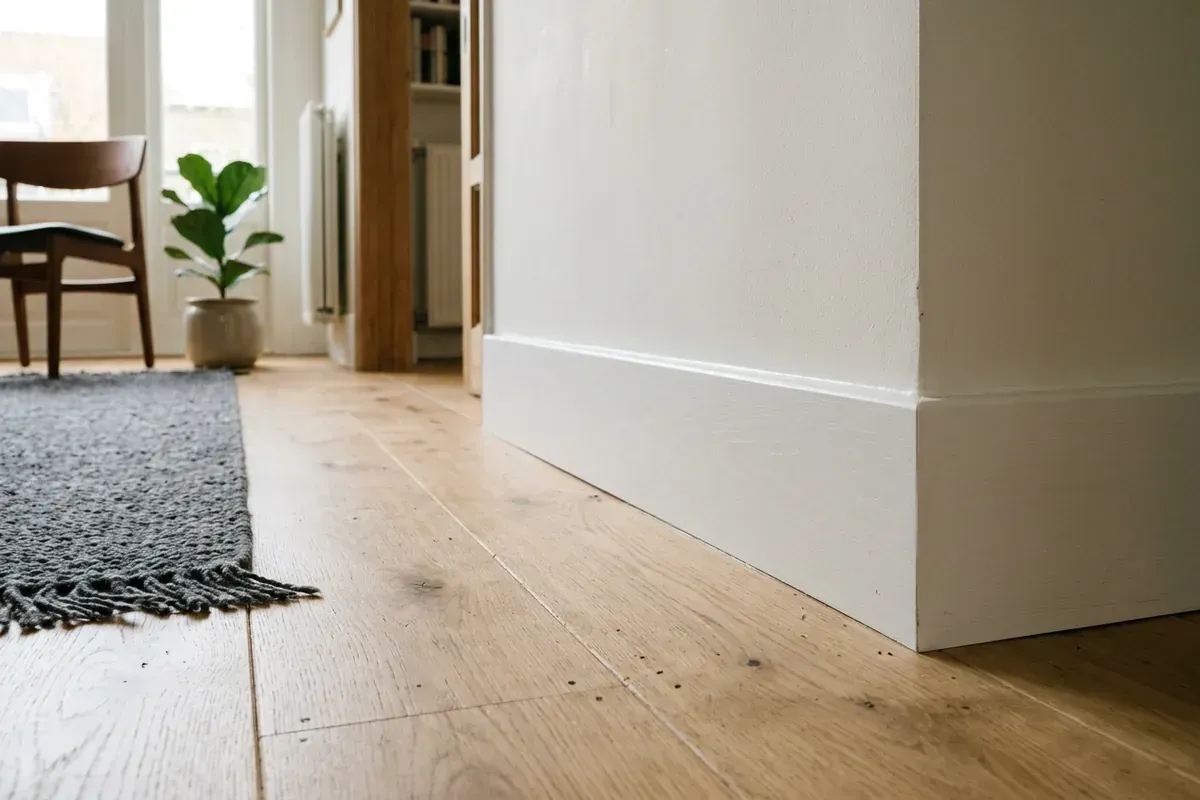
A white skirting board against a white wall looks less tall than the same skirting in a contrasting colour. If you choose a striking colour, such as black skirting in RAL 9005, every extra centimetre stands out. In that case a slightly lower skirting board often looks calmer. With skirting in the wall colour, you can actually go taller without it looking heavy.
Look at doors, architraves and frames
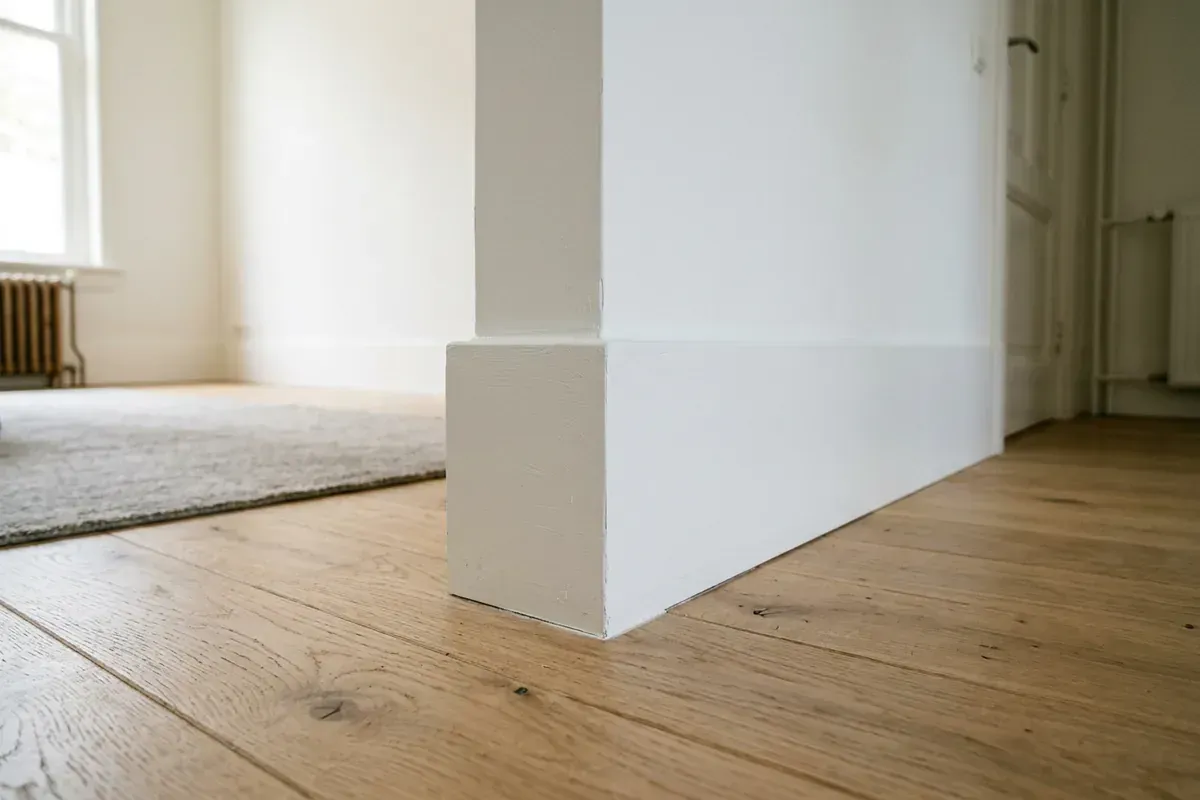
A skirting board almost always runs into a door frame or architrave. If the skirting is thicker or taller than the architrave is wide or deep, the junction looks restless. With tall skirting it is therefore wise to check how the skirting will finish against the frame. Sometimes an architrave or a neat end detail is needed to make it all work. See also our architraves service.
Why do people choose tall skirting boards?
- Appearance. A tall skirting board gives a room more character and completes a classic or sleek modern interior.
- Protecting the wall. Vacuum cleaners, chair legs and shoes hit the skirting before the wall.
- Covering old marks. During a renovation, damage, old plug holes or an uneven plaster edge are often left where the old skirting used to be. Taller skirting covers more. In some situations, overlay skirting is an alternative.
- Cables. Tall skirting offers more space at the back. If you want to hide cables, also read our article on skirting boards with a cable channel.
What should you look out for with tall skirting boards?
Out-of-true and uneven walls
The taller the skirting, the more of the wall it follows. A wall that is straight at the bottom but leans back a few millimetres at 15 cm will show a gap at the top of tall skirting. A skilled skirting fitter handles this with enough fixing points, light work on the wall where needed and neat caulking along the top edge. Old buildings with subsided walls need made-to-measure work, as at the historic home in Apeldoorn.
Sockets and pipes low in the wall
Are there wall sockets, heating pipes or radiator pipes low in the wall? Then measure in advance how much space there is below them. A skirting board that would run over the bottom of a socket has to be cut out or chosen lower. This is one of the points that becomes clear straight away during a site survey.
The mitres get bigger
With tall skirting, the mitre is also bigger, so a small deviation in the corner is more visible. Internal and external corners in a home are rarely exactly 90 degrees. A good mitre joint is therefore measured and cut corner by corner, not simply at 45 degrees.
Material and thickness
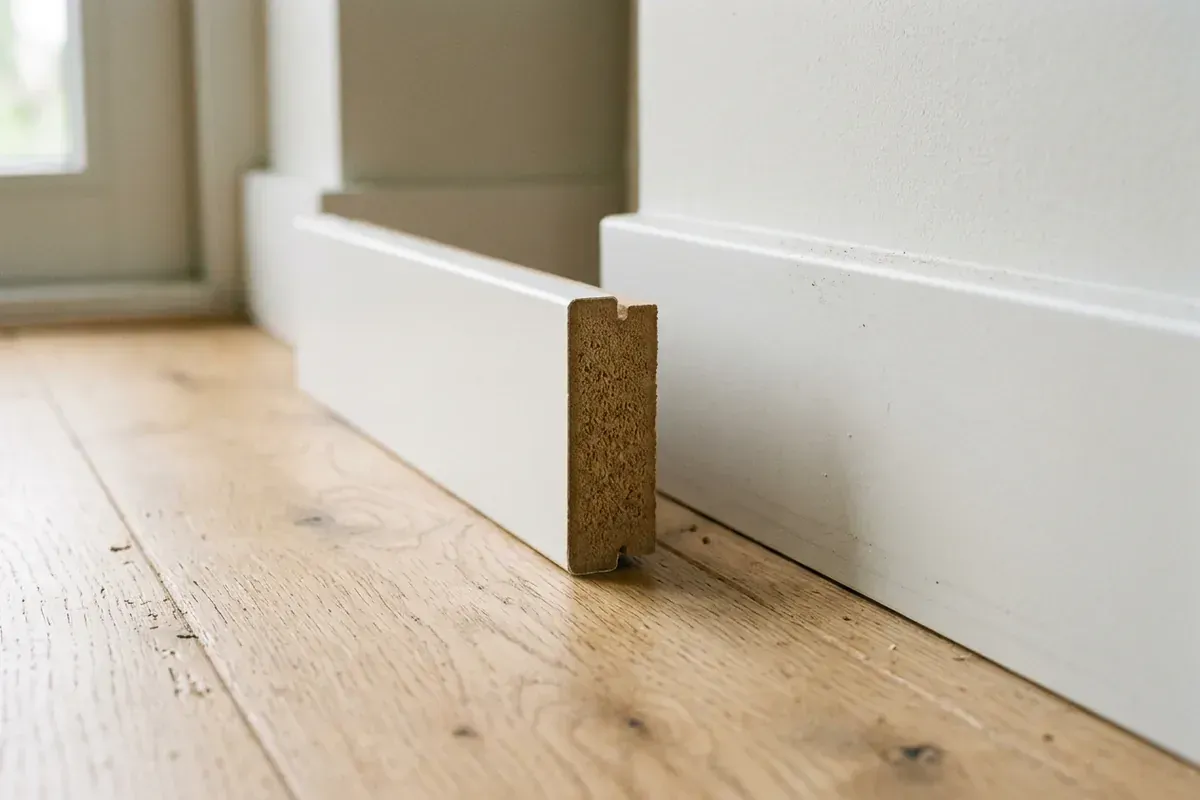
Tall skirting boards are usually made of MDF. MDF is dimensionally stable, barely moves and is smooth enough to be painted to a crisp finish in any RAL colour. For areas where moisture may occur, such as a utility room or a hallway by the front door, moisture-resistant MDF is a better choice. Solid wood suits listed buildings and interiors where other woodwork is visible too. Read more about the trade-off in MDF skirting boards: pros and cons.
Also pay attention to thickness. With a floating floor, the skirting has to fully cover the expansion gap along the wall. A tall but thin skirting board may then not cover enough.
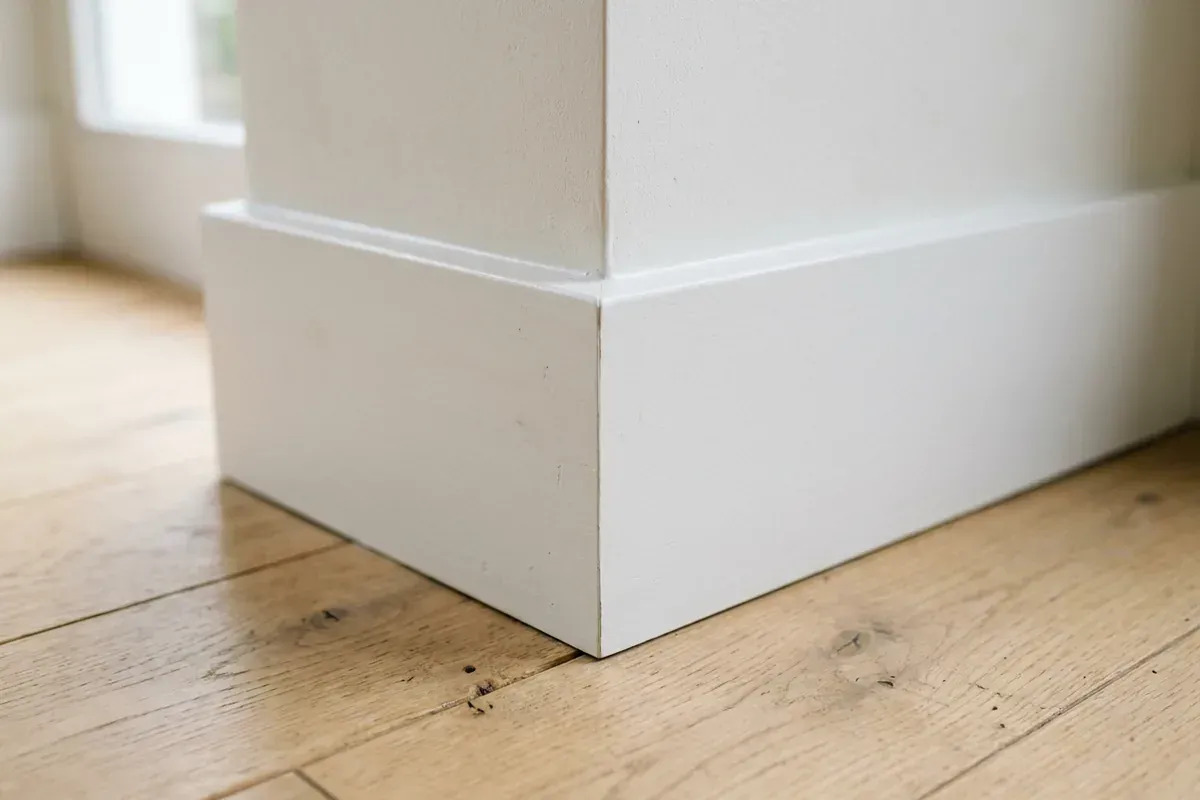
Profile: sleek, bevelled or classic?
Tall skirting boards come in different profiles:
- Straight and sleek, with a slightly rounded or square top. Suits modern and minimalist interiors.
- With a bevelled or quarter-round top edge, a timeless middle ground.
- Classically profiled, with an ogee or another decorative profile at the top. Suits 1930s homes, townhouses and interiors with decorative mouldings or coving.
If you combine tall skirting boards with other mouldings, such as decorative mouldings and coving, it pays to match the profiles.
Tall skirting: professional fitting or DIY?
Fitting standard skirting yourself is perfectly doable for handy people. With tall skirting, small inaccuracies become visible: a mitre that is a millimetre open, a top edge that does not sit tight or a skirting board that does not continue at the same height. Tall MDF skirting boards are also longer and heavier to handle, which makes cutting and fitting harder.
TipTop Plinten fits tall skirting boards in MDF, solid wood and aluminium, finished in any RAL colour, including crisp mitres and caulking. We do this for homeowners, but also for contractors, floor fitters and interior fitters. How long the installation takes depends on the number of metres, the number of corners and the condition of the walls; you will hear this with the quote.
How to choose the right height in three steps
- Measure the ceiling height and use the table above as a starting point.
- Tape a strip of paper or cardboard of 12, 15 and 18 cm to the wall and look at it from the doorway. That often tells you more than a drawing.
- Check for obstacles: sockets, radiator pipes, frames and the thickness of the architraves.
Advice or a quote for tall skirting boards?
Unsure about the right height, profile or colour? Send us a few photos of the room, the estimated number of linear metres and the floor type via the contact page. We are happy to communicate in English. The quote is free and without obligation. If you would like us to look at the situation in person, an on-site measurement is available for €75 incl. VAT; this amount is deducted as a discount for projects above a minimum size.
Frequently asked questions
In the trade, skirting boards from about 12 cm upwards are usually called tall. Popular heights are 12, 15 and 18 cm, and taller profiles exist for very high rooms. Which height suits you depends mainly on the ceiling height and the style of the interior.
They can be, but be careful with very tall skirting in a small room with a low ceiling. Skirting in the same colour as the wall stands out less and keeps the room looking calmer. If in doubt, it helps to hold a few heights cut from paper against the wall.
Yes. The taller the skirting, the greater the chance that the top edge does not sit flat against the wall everywhere. This is handled with the right fixing and neat caulking along the top so that no shadow gap remains visible.
MDF is the most popular choice, because it is dimensionally stable and can be finished smoothly in any RAL colour. Solid wood suits classic and listed interiors. TipTop Plinten works with MDF, solid wood and aluminium, and deliberately not with plastic.
That depends on the number of linear metres, the height and material of the skirting, the number of corners and whether caulking is included. You will receive a free quote based on your situation. An on-site measurement is available for €75 incl. VAT.
Related articles
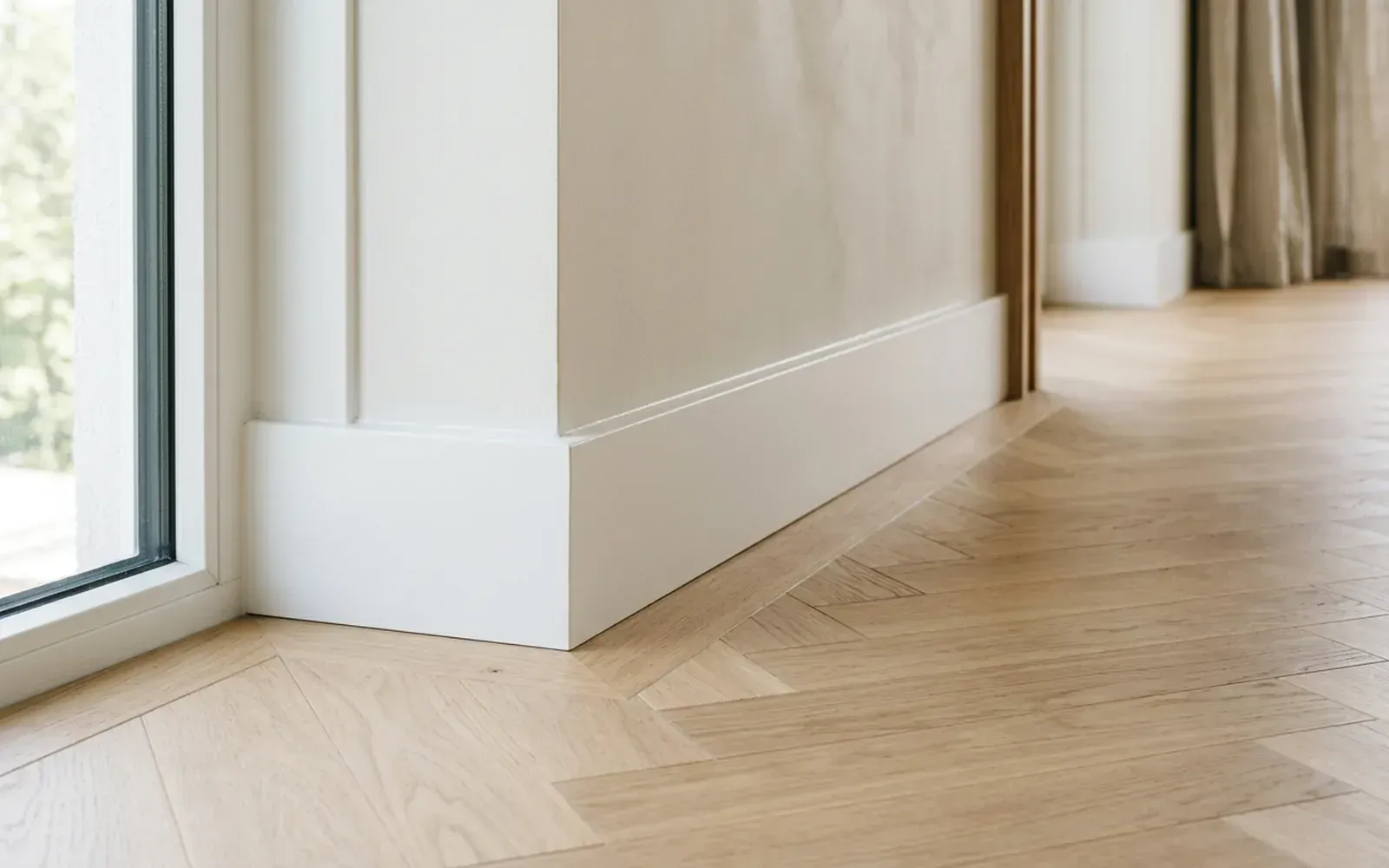
Choosing skirting
MDF skirting boards: pros, cons and when to choose them
MDF is the most popular material for skirting boards, but not the best choice in every situation. These are the advantages, the disadvantages and the pitfalls.
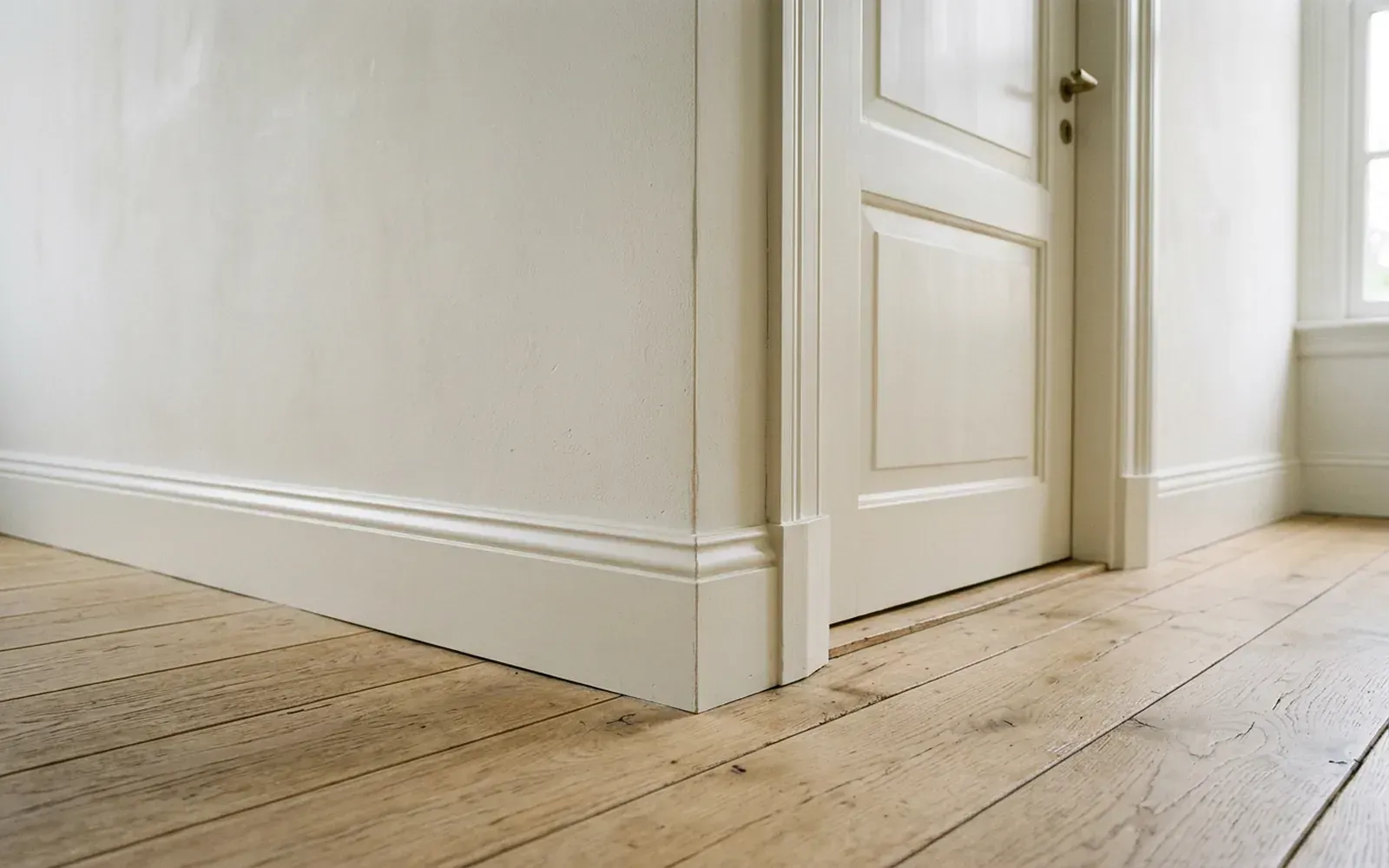
Choosing skirting
White skirting boards: RAL 9010 or RAL 9016?
White is not just white. The difference between RAL 9010 and RAL 9016 seems small, but next to a white door or wall you notice it straight away.
Choosing skirting
Overlay skirting boards: when are they a smart choice?
Removing old skirting can damage plaster or tiles. Overlay skirting goes over the top instead. Here is how to tell whether that is sensible in your situation.
Related
Tall skirting
Tall skirting is usually 12 cm or higher. It gives a room calm and elegance, provided the height suits the ceiling and the interior.
Skirting board
A skirting board is the moulding at the base of the wall that finishes the transition to the floor and protects the wall. Here is how it works and what to look out for.
MDF
MDF is a sheet material made of pressed wood fibres. It is stable, smooth and easy to paint, which makes it the most popular material for skirting boards.
Linear metre
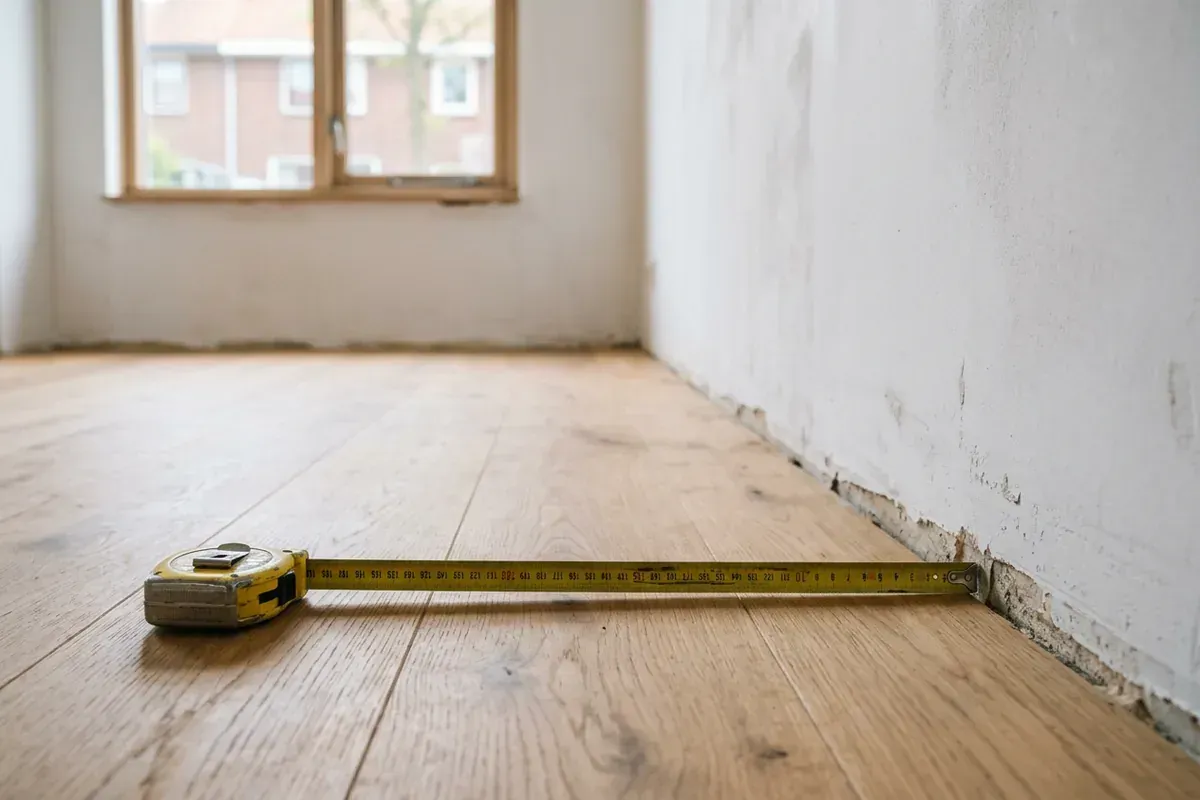
A linear metre is a metre measured along the length, regardless of width or height. Skirting boards and mouldings are measured and ordered this way.
Caulking
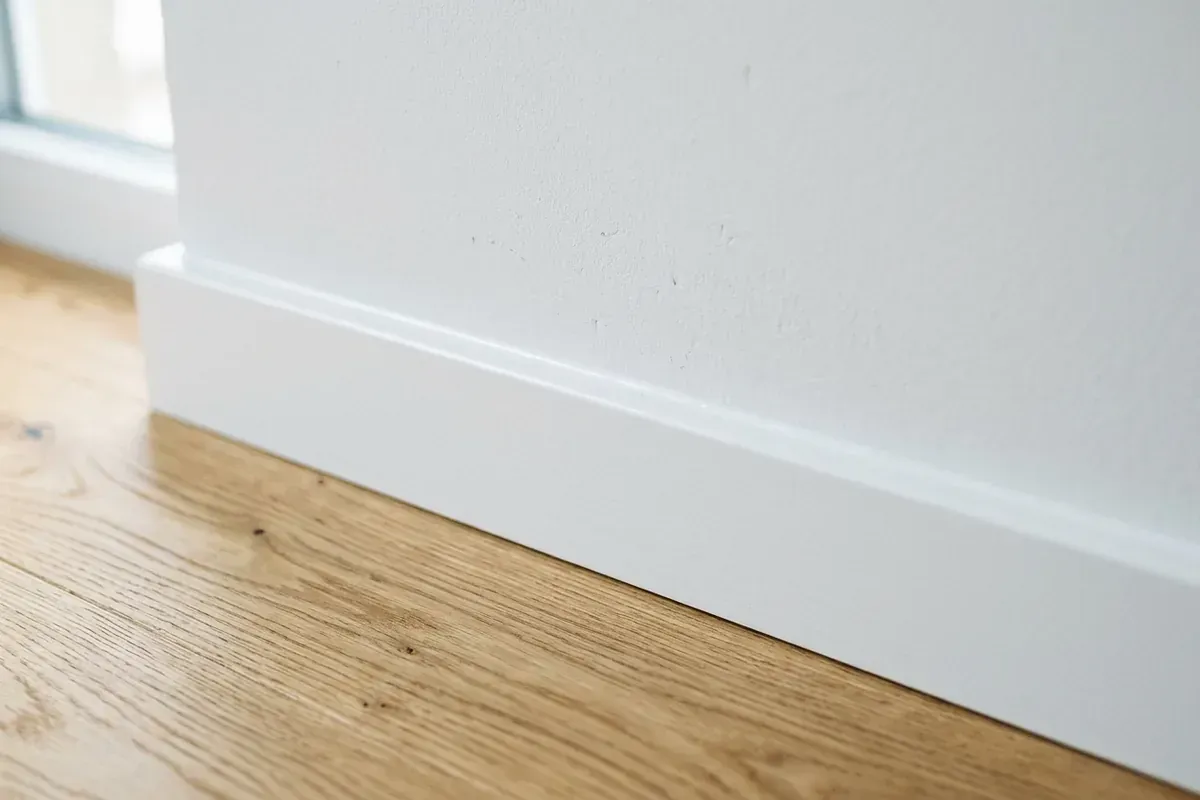
Caulking means sealing joints with a flexible sealant. With skirting boards and mouldings, it makes the transition to the wall crisp and seamless.
Skirting board installation by a specialist skirting fitter
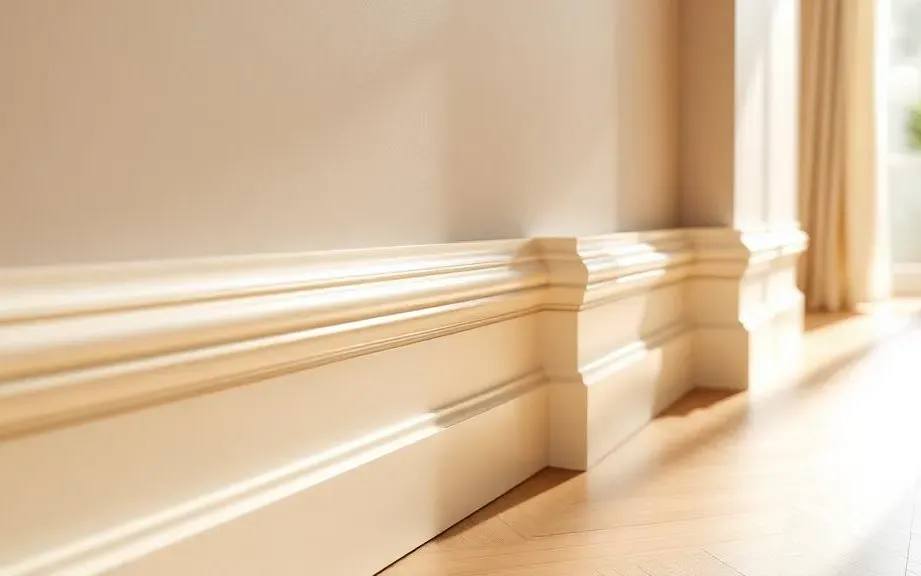
TipTop Plinten fits skirting boards in MDF, solid wood and aluminium, finished in any RAL colour and neatly matched to any floor, even with uneven walls.
Caulking skirting boards and sealant work for a seamless finish
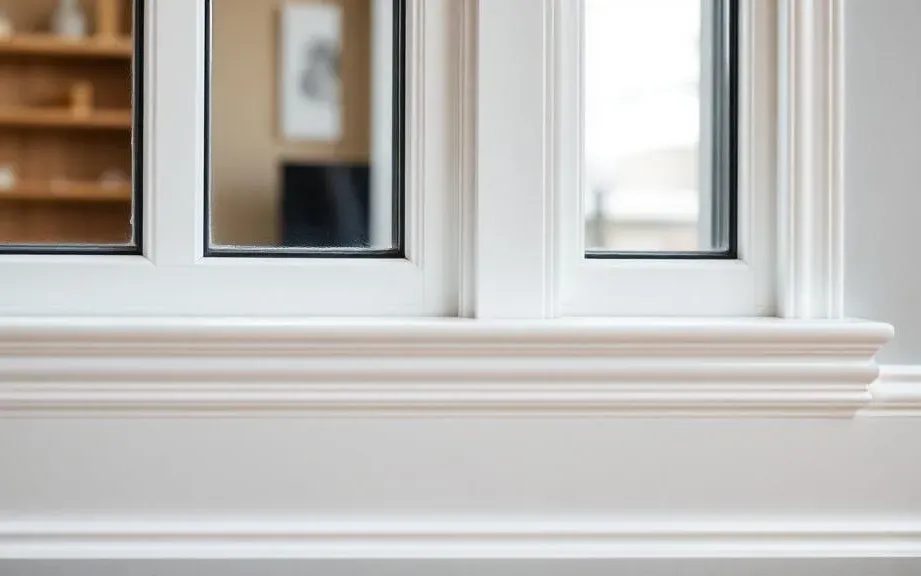
Caulking is the final step that makes skirting boards, mouldings and panels look seamless. TipTop Plinten uses acrylic or silicone, paint-ready or in colour.
Skirting board installation? Request a free quote
On-site measurement €75 incl. VAT (credited for orders above a minimum project size)